How to teach skip counting by 2, 5 and 10 with household objects
Learn how to teach skip counting with bottle caps, spoons, buttons and simple movement before using charts and written practice. You will also find a free printable skip-counting chart and three worksheet levels for children from UKG to Class 3.
In short
- Skip counting means counting equal groups by the same number each time.
- Household objects help children see groups of 2, 5 and 10 before they write number patterns.
- A printable chart and levelled worksheets can move practice from objects to written maths.
- Begin with one counting rule and adjust the number of groups to suit your child.
What is skip counting?
Skip counting means counting equal groups by the same number instead of saying every number one by one. If your child has pairs of socks, the totals are 2, 4, 6, 8 and 10. The child is counting one group of two at a time.
The first patterns to practise are:
- By 2: 2, 4, 6, 8, 10
- By 5: 5, 10, 15, 20
- By 10: 10, 20, 30, 40
This idea supports early maths work in UKG and Class 1, then helps with multiplication and mental maths in Class 2 and Class 3. Children do not all learn the patterns at the same speed. Some children need to handle objects for several days, while others are ready to use a chart sooner. Keep the purpose clear: each number tells you the total after adding one equal group.
Start with bottle caps, spoons or buttons
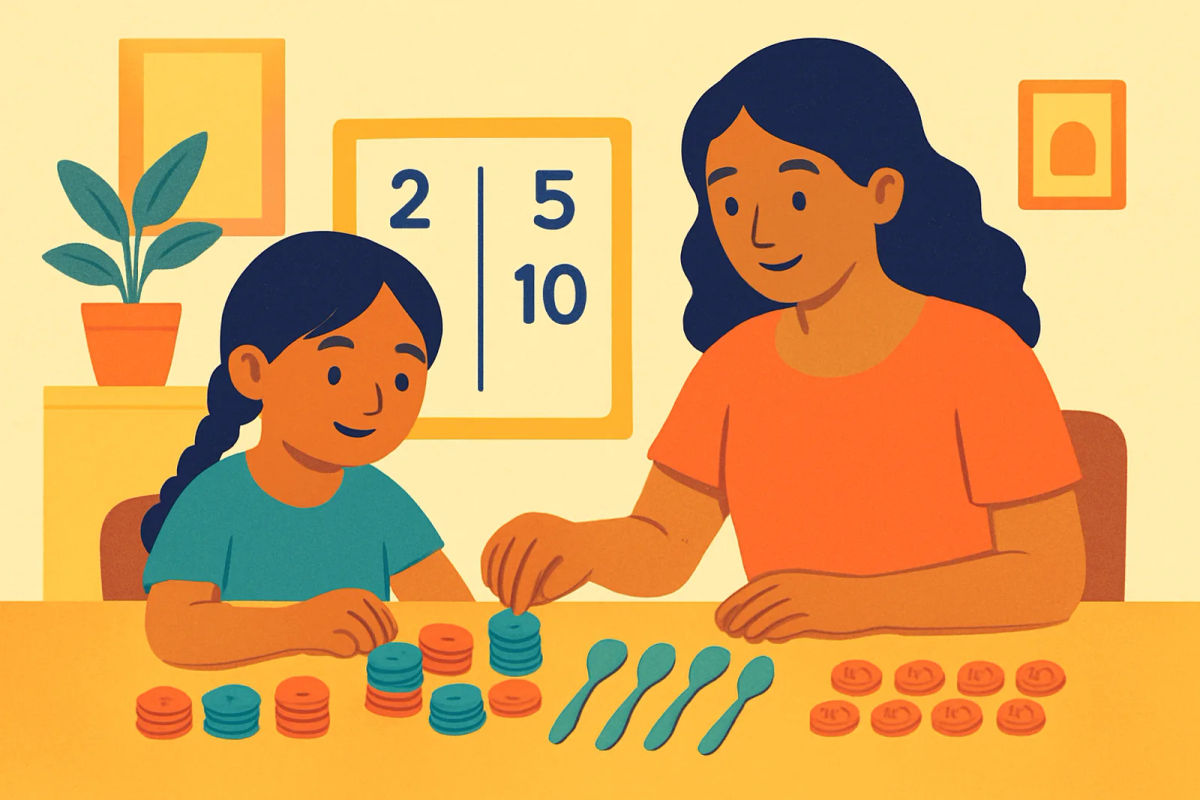
Ask your child to collect safe household objects such as large bottle caps, spoons or large buttons. Avoid small objects if a young child may put them in their mouth, and stay nearby during the activity. A tray or mat can help keep the groups neat.
For counting by 2, place objects in pairs. For counting by 5, make groups of five. For counting by 10, make groups of ten. Start with two or three groups for a young child. Touch each group and say the total aloud together. For example, touch the first group of five and say 5, then touch the second group and say 10.
After a few turns, pause and ask, "What number comes next?" Let your child build the next group before answering. You can use a free printable math counting worksheet later, but begin with real objects so the pattern has a clear meaning.
Practise skip counting through movement and talk
Movement gives your child another way to remember the repeated jump. Ask your child to clap, tap the table or take one step for each group. For counting by 2, make one clap while saying 2, then another while saying 4. Keep the objects in front of the child at first, so the movement supports the groups rather than replacing them.
Use familiar examples from home. Two socks make a pair, five fingers are on one hand and ten fingers are on two hands. At snack time, place five biscuits on each plate and ask for the total on two plates. In a classroom, children can make groups with bottle caps and say the total together.
Mix in short questions without making the activity feel like a test. Ask, "How many objects are there in four groups of 5?" or "How many pairs make 10?" If your child needs help, arrange the groups in rows and count them together before asking again.

Lumi's tips
- Lumi suggests placing the objects on a tray so your child can see each equal group clearly.
- Say the pattern slowly with your child before asking for an answer alone.
- Keep one small bag of large caps or buttons ready for a five-minute maths activity.
- If a worksheet feels difficult, return to the matching objects before giving more written questions.
Move from objects to a number chart
Once your child can make equal groups, use the free printable skip-counting chart from this page. Print it on A4 or US Letter paper at Actual size, or place it in a clear folder and use a wipe-clean pen. Ask your child to circle or colour every second, fifth or tenth number.
Talk about what the child notices. Counting by 2 lands on even numbers. Counting by 5 lands on numbers ending in 0 or 5. Counting by 10 lands on numbers ending in 0. These patterns are useful clues, but your child should still understand the groups behind the numbers.
Cover a few numbers with small pieces of paper. Ask your child to fill in the missing numbers, then write the full pattern from memory. Begin with 2, 4, 6, 8 and move to longer patterns later. If your child is still forming numerals, practise with the free printable number tracing worksheets alongside the chart.
Use three levels of maths worksheets
Choose a worksheet that matches what your child can explain with objects. A child may be confident with counting by 2 but need more time for counting by 5 or 10. Use one level for a few short sessions rather than giving a large stack of pages.
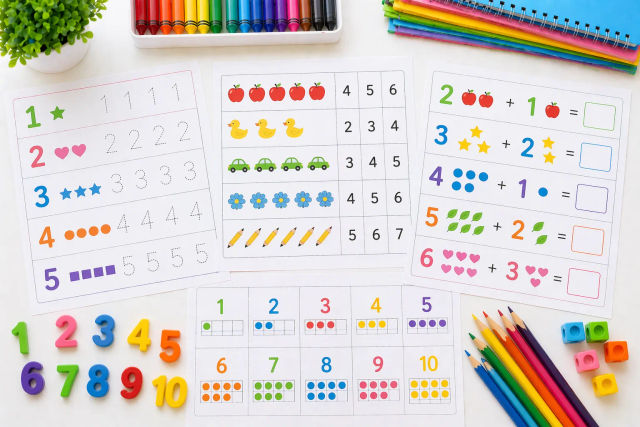
Level 1: early learners and Class 1. Use tracing, colouring, matching groups to numbers and short patterns such as 2, 4, __, 8. Pictures of grouped objects are helpful.
Level 2: Class 1 and Class 2. Use missing numbers, number lines, simple groups and questions such as 3 groups of 5. Ask the child to draw groups when a question feels too abstract.
Level 3: Class 2 and Class 3. Use longer patterns, mixed counting by 2, 5 and 10, word problems and questions that ask the child to find the rule.
You can print worksheets as PDFs on A4 or US Letter paper at Actual size. For extra practice with a chosen range, use the Math Worksheet Generator. Keep the page for your own home or classroom use.
Make skip counting easier or harder
To make the activity easier, use fewer groups and keep the objects in neat rows. Say the pattern together once or twice before asking your child to continue alone. You can also write the first two numbers on a small card, such as 5 and 10, as a reminder.
If your child is ready for more challenge, start from a number other than 0. Try 3, 7 or 25 and ask what comes next after several jumps. For example, counting by 5 from 7 gives 7, 12, 17 and 22. Use objects or a number line if the new starting point causes confusion.
In a class, let pairs use different objects. One pair can use spoons, another can use caps and another can use buttons. Ask them to compare the totals after three groups. The objects look different, but the same number pattern appears when the group size stays the same. This helps children see that skip counting is about the number in each group, not the kind of object.
Common mistakes to watch for
Watch to see whether your child is counting the groups or counting every object one by one. Counting each object is useful at an earlier stage, but it can hide the skip-counting pattern. Ask the child to touch one whole group, say its total and then move to the next group.
Do not mix groups of 2, 5 and 10 in the first activity. Practise one pattern clearly before changing the rule. If your child writes 2, 4, 8, 10, return to the objects. Make four pairs and have the child touch each pair while saying 2, 4, 6, 8.
A tired child may make mistakes even after understanding the idea. Stop when the activity is no longer going well and practise briefly another day. You can finish with one easy question your child knows, such as, "What comes after 10 when we count by 5?" Keep the tone calm and use the objects again whenever the written pattern feels confusing.
Questions parents ask
What age should a child start learning skip counting?
Many children can begin informally in UKG or around age 5, using pairs, fingers and small groups. Class 1 children may begin writing short patterns, while Class 2 and Class 3 children often use skip counting in multiplication and word problems. Start when your child can count objects reliably, and do not rush the written work.
How can I teach skip counting by 2, 5 and 10 without worksheets?
Make pairs of socks, groups of five fingers or groups of ten bottle caps. Let your child clap, tap or step once for each group while saying the total. Ask questions such as how many objects are in three groups, then build the answer together.
Why does my child find skip counting difficult?
The child may be remembering a word sequence without seeing the equal groups, or may be mixing different counting rules. Return to two or three neat groups, touch each group and say the total aloud. Short practice on several days is usually more useful than one long session.
Which household objects are safe and useful for skip-counting practice?
Large bottle caps, spoons and large buttons work well when a child is supervised. Choose objects that are easy to separate into neat groups and avoid small items for children who may put them in their mouths. Socks, pencils and toy blocks can also work if your child can make equal groups with them.
How can I make a skip-counting worksheet for my child's level?
Begin with tracing and short missing-number patterns for early learners. Add number lines and group questions for Class 1 and Class 2, then use mixed patterns, word problems and rule-finding for Class 2 and Class 3. The [Math Worksheet Generator](/tools/math-worksheet-generator/) can create extra practice with a chosen range.