
Means of Communication Worksheets
These means of communication worksheets help children aged 3 to 8 learn how people share news, messages and ideas. The free printables include simple picture activities, matching, sorting, tracing and drawing tasks for home or classroom use.
Free account needed to download · 20 free downloads every day

Coming soon
Means of Communication Worksheets are coming soon
Our team is drawing and testing these printables right now. Save this page or join free, and we'll let you know when they are ready to download.
At a glance
- Ages: 3 to 8 years
- Skills: Vocabulary, matching, sorting and fine motor practice
- You need: Printed worksheet, pencil and crayons
- Time: 10 to 20 minutes per activity
What children learn from this set
The worksheets introduce familiar means of communication such as letters, telephones, mobile phones, radio, television, newspapers, computers and email. Younger children can identify pictures, match an object to its use and trace simple words. Older children can sort old and new ways of sharing information, complete labels, answer short questions and draw a way they communicate with family. The activities use everyday examples rather than difficult technical terms, so they suit Nursery, LKG, UKG and early primary learners. You can pair them with Our Neighbourhood Worksheets when discussing the post office and other community places.
Simple ways to use the worksheets
At home, begin with a short talk about how your child speaks to a family member who is nearby and how they might send a message to someone far away. Let your child point to real objects such as a phone, newspaper or letter before starting the sheet. In class, place picture cards around the room and ask children to sort them into speaking, writing, listening or viewing. Children can role-play posting a letter, making a phone call or reading a news report. Finish with a drawing task, such as showing how they would send a birthday message to a relative.
Clear up common mix-ups
Children may confuse a device with the message it carries. For example, a phone is a tool for communication, while speaking is the way a message is shared. They may also call every screen a television or think that a letter and an email are the same. Ask, 'What do we use?' and 'What do we do with it?' before giving the answer. Use familiar examples from your home, and explain that some methods need the internet while others do not. Remind children never to call, message or share personal details online without a trusted adult.

Lumi's tips
- For younger children, cover the word labels and ask them to name each picture before matching it.
- For older children, ask them to compare a letter, a phone call and an email by sorting them by speed, writing and equipment needed.
- Keep the topic connected to real life by inviting your child to notice a postbox, newspaper, phone shop or television during a walk.
How to download and print
- Sign in or join free, it takes a few seconds.
- Choose a page and tap Download. Pick A4 or US Letter to match your paper.
- Open the PDF and print at "Actual size" (100%) so nothing is cut off.
- Your downloads stay in My Library, so you can print them again any time.
Questions parents ask
What are means of communication for children?
Means of communication are the tools and methods people use to share messages, news and ideas. Examples include speaking, letters, telephones, radio, television, newspapers, computers and email.
What do children learn from means of communication worksheets?
Children learn to recognise communication tools, match each tool with its use, sort old and newer methods, and use related vocabulary. Older children can also compare how different methods share messages.
Are these worksheets suitable for Nursery and UKG children?
Yes. The simpler activities use pictures, matching, tracing and colouring for younger learners. Adults can read the labels and discuss each picture while the child works.
Can I use these worksheets in a classroom?
Yes. They can support an EVS lesson, a speaking activity or a topic display. Children can work alone, with a partner or in a small group after a short discussion.
How do I download and print these worksheets?
Create a free EarlyActivity account to download the printable PDF. Print it at home or in your own classroom, and use the worksheet for personal learning activities.
More all about me & my world
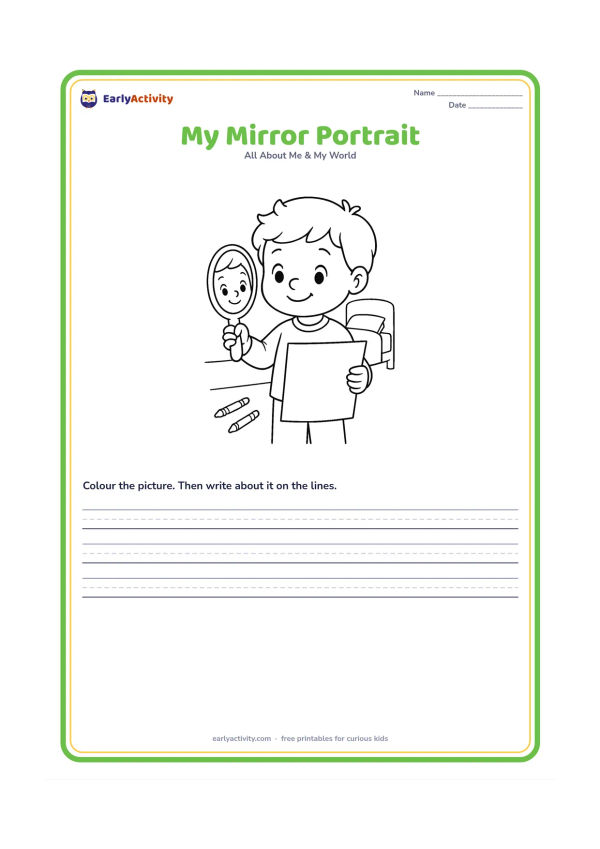
All About Me Worksheets
These all about me worksheets help children learn and share simple facts about themselves, including their name, age, likes, feelings, body parts and abilities. They suit children aged 3 to 8 and are free to download and print for use at home or in your own classroom.

Means of Transport Worksheets
These means of transport worksheets help children aged 3 to 8 learn about vehicles used on land, in water and in the air. The free activities include colouring, matching, sorting, tracing and simple road safety ideas for home or school.
My Family Worksheets
This set of my family worksheets helps children aged 3 to 8 name family members, talk about relationships and share simple details about home life. The worksheets are free to print for use at home or in your own classroom.
My House Worksheets
This set of my house worksheets helps children aged 3 to 8 learn about rooms, household objects and simple home routines. The activities are free to download and print for use at home or in your own classroom.
My School Worksheets
These my school worksheets help children aged 3 to 8 learn about classrooms, school objects, people at school and daily routines. They are free to print and suit home practice, nursery, LKG, UKG and primary classrooms.
Our Helpers Worksheets
These our helpers worksheets introduce children aged 3 to 8 to people who help us at home, school and in the community. The free printables include simple matching, colouring, tracing, sorting and early reading activities for home or classroom use.