Children's Day activities for preschoolers: a simple Nursery and LKG learning corner
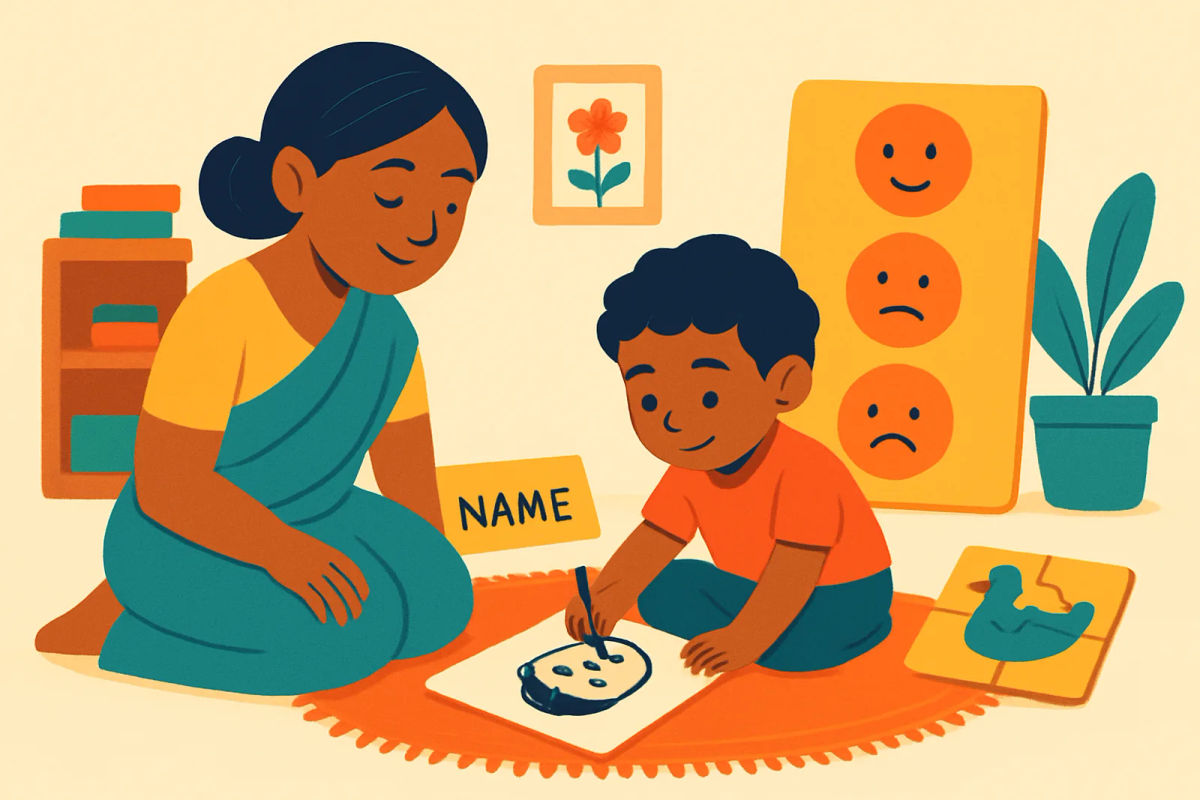
Set up a small Children's Day learning corner where your child can draw, recognise their name, share a feeling and solve a simple puzzle. These Children's Day activities for preschoolers help you make time for the child's ideas at home or in a Nursery or LKG classroom.
In short
- Use four simple activities to give your child different ways to draw, talk, recognise letters and solve a puzzle.
- Let Nursery children point, match and add marks, while LKG children try more copying, sorting and speaking.
- Give your child a choice about the activity, the materials and how much they want to share.
- Treat the corner as a quiet place for ideas, not a competition or a display contest.
What to place in the learning corner
Choose a small table, a mat on the floor or one clear corner of a shelf. Place four activities within reach: a self-portrait page, a name card, a feelings chart and a choice puzzle. Keep crayons, pencils, glue and a few familiar objects nearby, such as a comb, cup, ball or toy spoon. These objects can give your child ideas when they are not sure what to draw or match.
Use one tray or folder for the printables. Leave enough open space for drawing, placing puzzle pieces and talking with an adult. You can add a small basket for finished work, but there is no need to make a large display.
Before your child begins, explain that the corner is a place to share ideas. It is not a race, a competition or a test of who makes the neatest picture. A child may finish one activity, move between two activities or simply talk about the materials. You can also use the ideas from Children's Day activities when planning the rest of the day.
How to prepare the self-portrait page
Invite your child to draw their face, hair, clothes and one thing they enjoy doing. You might ask, "What do you look like today?" or "What do you like doing with your family?" Give the child time to answer with words, marks or a picture. Write down their words beside the drawing if they agree.
For Nursery, offer a simple face outline. Your child can add eyes, hair, ears and colours without needing to draw the whole body. You can name each part as the child works. For LKG, leave more open space and invite the child to add their name, favourite colour or a family member. A child might draw a person as a circle, use unusual colours or leave part of the page blank.
Accept unusual colours and unfinished drawings. The child's words and choices matter more than a neat final picture. If drawing feels difficult, let the child point to colours, choose clothes for a paper figure or tell you what to add. The aim is to hear the child's voice, not to make every page look the same.
How to make a name card a child can use
Write the child's name clearly in capital and small letters on a card. Leave space below for the child to trace, copy or decorate it. You can make a personalised practice page with the name tracing worksheet maker, then keep one plain card for everyday use.
Nursery children can match their name card to a name label, point to the first letter or find their card among two or three cards. They do not need to write the name. You can say the name slowly and notice the first letter without asking the child to repeat it many times.
LKG children can try writing the first letter, copying the whole name or finding the same letter in a book. Accept a mixture of capital and small letters, reversals and marks that are still developing. Use the card during circle time, at the activity table or near the child's bag after Children's Day. The card becomes useful when the child sees their name in ordinary classroom routines, rather than only on a special worksheet.

Lumi's tips
- Lumi suggests placing the feelings chart where your child can point to it without asking for help.
- Keep one familiar object near the self-portrait page to give your child a starting idea.
- If the name card feels difficult, begin with matching the first letter rather than tracing the whole name.
- Let your child choose the order of the four activities and stop when the corner no longer feels enjoyable.
How to use the feelings chart
Prepare three or four simple faces with clear words below them, such as happy, sad, angry and worried. Keep the expressions easy to tell apart. Ask, "How do you feel today?" Your child can point, circle a face or draw their own face instead of answering aloud.
After the child chooses a feeling, offer a gentle next choice. They might sit quietly for a few minutes, take a drink of water or tell a trusted adult what happened. You can say, "Would you like to sit with me or have some water?" Keep your voice calm and allow the child to change their answer.
Do not force a child to share personal details or label a feeling for them. You can say, "You can point if you want to," and leave the chart available. In a classroom, the chart should support a brief check-in, not make a child speak in front of everyone. If a child shares something worrying, listen carefully, thank them for telling you and follow your school's safeguarding process or seek suitable adult help. The feelings chart is not a way to investigate or solve a serious concern.
How to add the choice puzzle
Offer a small matching or picture puzzle with familiar objects, colours, shapes or actions. Use pictures of things your child sees at home or school, such as a bag, pencil, plate, leaf or shoe. Let the child choose the puzzle and decide whether to work alone, with a friend or with an adult.
For Nursery, use fewer large pieces and name each picture while the child matches it. You can place two pieces in front of the child and ask, "Which one goes with the cup?" Give the child time to try before helping. A simple picture pair or two-part puzzle is enough.
For LKG, add one sorting rule. The child might match beginning sounds, colours or things used at school. For example, pencils and books can go in one group, while a ball and a spoon go in another. Ask the child to explain the rule in their own words. If the rule changes, accept that as part of the play and ask what the new groups mean. The puzzle should give children a choice and a chance to explain, not another timed task.
How to run the station at home or school
Allow about 15 to 25 minutes, or let the child stop after completing one or two parts. Preschool children may need a movement break, a drink or a quiet pause. It is fine if the corner is used in short visits across the day.
At home, place it near the child's usual drawing space. Invite a parent, grandparent or sibling to listen, but avoid taking over the page. In a Nursery or LKG classroom, call two or three children at a time. Keep the remaining children with a quiet book, blocks or another familiar activity. A small group makes it easier to hear each child's words.
Ask open questions such as "Tell me about your picture," "How did you choose this group?" or "What would you like me to write?" Avoid correcting the drawing, rushing the child or comparing children. If two children want the same material, offer a turn or another colour. You can write a short sentence beside the work, using the child's own words where possible. This keeps the focus on what the child meant, not just on how the page looks.
What to print and what to avoid
Print the self-portrait page, name card, feelings chart and puzzle on A4 or US Letter paper at Actual size, or 100 percent. Check that the words and picture areas are clear before printing. Keep a few spare plain sheets nearby for extra drawing or for a child who wants to start again. You can find more suitable pages in the free printables library.
A printable keeps preparation short. A simple name or drawing maker can help when you need a quick personalised page. For example, the name tracing worksheet maker can create a practice page, while a photograph-based page may need an adult to check the image before it is printed.
Avoid too many decorations, writing tasks or timed challenges. They can take attention away from the child's voice. Do not require every child to complete every part. Save the child's words beside the work, with their permission, so a display shows what they meant rather than only how it looks. For home or classroom use, print only what you need and keep the rest of the space open for conversation.
Questions parents ask
How long should a Children's Day learning corner stay open for Nursery and LKG children?
Keep the station available for about 15 to 25 minutes at a time. A child may stop after one or two activities and return later. In school, small groups of two or three children can use it while others have a quiet book or block activity.
What can I do if my child does not want to draw a self-portrait?
Do not insist on a face drawing. Offer choices such as drawing a favourite object, choosing colours, decorating a face outline or telling you what to draw. Write down the child's words only if they want you to.
How can I adapt the activities for a child who is not writing their name yet?
Let the child match their name card to a label, point to the first letter, trace one letter or make marks beside the printed name. You can say the name naturally during the activity without asking the child to copy it.
Should I use the feelings chart if a child shares something worrying?
Listen calmly and thank the child for telling you. Do not question them repeatedly or promise to keep a serious concern secret. Follow your school's safeguarding process or speak with a suitable trusted adult who can help keep the child safe.
Can I set up the corner with only a printer, crayons and paper?
Yes. Print the four activity pages, use crayons for drawing and marking, and fold or cut paper for a simple matching puzzle. A tray is helpful but not needed, and you can use household objects if you want to add a matching activity.