How to get kids to do holiday homework without daily arguments
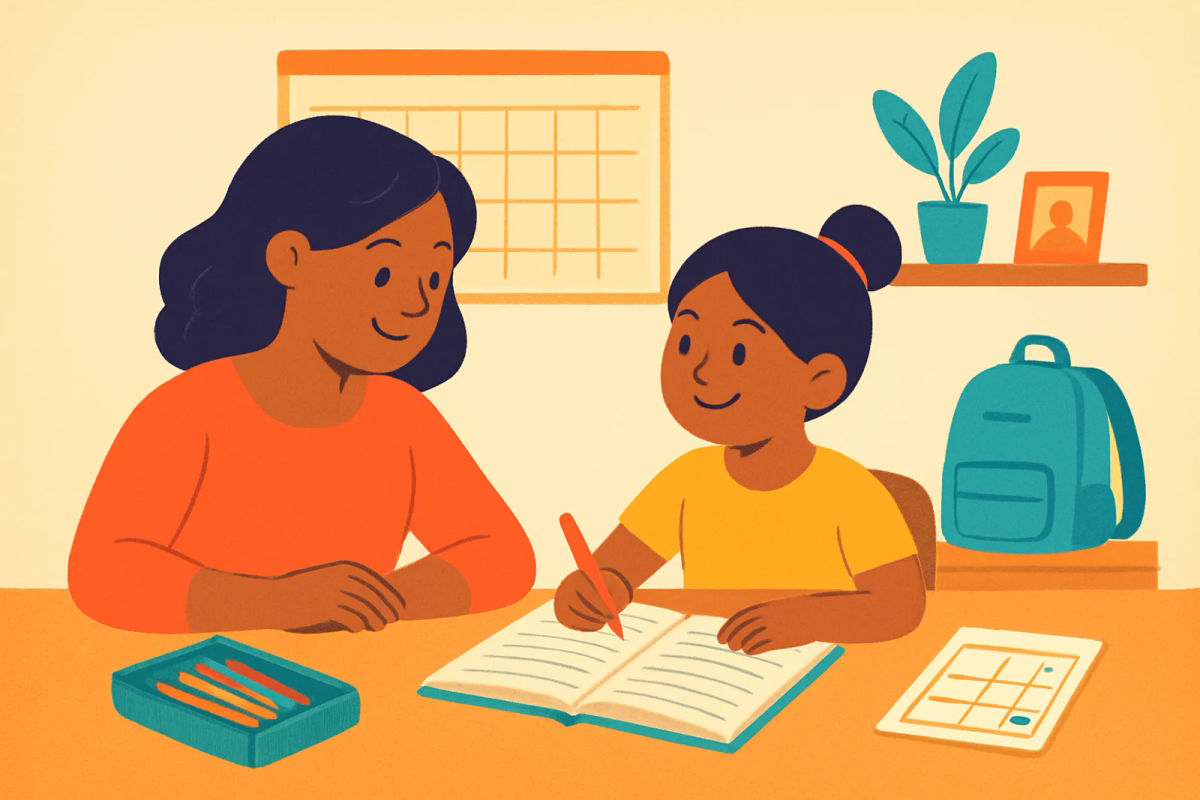
A short weekly plan can make holiday homework feel manageable without turning every morning into a struggle. This guide shows you how to divide work into small tasks, protect rest and family time, and use a simple chart so your child can see what is finished.
In short
- Plan holiday homework once a week instead of giving repeated reminders each day.
- Break broad instructions into small tasks that your child can start and finish.
- Keep space for sleep, play, travel, festivals and family visits.
- Use a tracker, checklist and completion chart to make progress visible without rewards.
- Ask the teacher for help when the amount, deadline or required format is unclear.
Why holiday homework turns into daily arguments
Holiday homework often becomes a source of conflict when the instructions are unclear, the unfinished work looks large or the deadline suddenly feels close. A child may hear repeated reminders but still not know which task to start, how long it will take or what materials are needed. Parents then feel they must keep asking, and the child begins to resist the reminder itself.
Children also need sleep, play, quiet time and family time during a holiday. A full school-day routine at home can make the break feel like an extension of school. This is especially noticeable during summer holidays, festivals or visits to grandparents.
Replace daily reminders with one calm planning conversation each week. Sit with your child, check the homework list and agree on a few small work times. Write the plan where both of you can see it. During the week, point to the plan rather than repeating the whole instruction. If the plan stops working, change it together at the next weekly check.
Make a short weekly plan with your child
Choose one regular day, such as Sunday evening, to look at the homework list together. Note school deadlines, travel plans, family visits and any day when your child is likely to be tired. Then choose a small number of work sessions for the week. Three 20-minute sessions on weekday mornings may suit one child, while another may work better after an afternoon rest.
Give your child some control over the timing. You might ask, Would you like to read before breakfast or after your bath? You keep the final limits for bedtime, outings and school submission dates, but your child can choose between reasonable options. This makes the plan shared rather than imposed.
Keep only a small amount of unfinished work visible. A notebook, the next worksheet and a pencil box are enough for the next session. Store the remaining books and project materials nearby but out of sight. If the list looks too large, divide it by week and mark what can wait. You can keep the plan on a printable page from the free printables library and review it together.
Break each subject into small tasks
Broad instructions such as complete your holiday homework can feel too big to begin. Turn them into clear actions: read two pages, solve five sums, colour one picture, label three parts or write three sentences. A child can understand and finish one action more easily than a whole subject.
For Nursery, LKG and UKG, keep activities brief. An adult may need to read the instructions, find the correct book and prepare crayons, glue or pencils. One tracing line, one picture to colour or a short oral practice can be enough for one sitting. Give a little help with starting, then let the child do the part they can manage.
For Class 1 to 5, ask your child to estimate the time for a worksheet, reading task or project step. Help adjust the estimate without doing the work. A maths task might become five sums, a short break, then five more. A project can be divided into choosing information, drawing, writing labels and checking the notebook. Add breaks between writing, reading and maths, especially when your child begins to lose focus. If extra maths practice is needed, a math worksheet generator can make a short set rather than a long page.

Lumi's tips
- Lumi suggests keeping tomorrow's task visible and the rest tucked away, so the page feels calm.
- Lumi's small start is to place the right book and pencil on the table before calling your child.
- If a task feels too long, ask Lumi to help you split it into the smallest clear action.
- Let your child colour a finished box, then close the chart until the next planned work time.
Leave room for rest and family visits
Place homework around the holiday, not in every empty space. Protect sleep, outdoor play, reading for pleasure, festivals, travel and visits with relatives. A child who has had a late family evening may need a lighter morning. You can keep one small task for that day and move a longer task to a planned work session later.
Before changing the plan, check which work can wait and which item has a fixed school deadline. A notebook entry due on the first day back may need attention before a project with a later submission date. If travel is involved, pack only the books and materials needed for one or two small tasks. Do not carry the entire school bag if it makes the holiday feel like school.
Prepare a quiet work corner with pencils, an eraser, notebooks and the required books. Keep glue, scissors and coloured paper together if a project needs them. During a family visit, a child might read a few pages or complete a small drawing, then return to the longer task at home. For ideas that fit a relaxed break, you can use these summer activities for kids alongside the homework plan.
Use a tracker, checklist and completion chart
A tracker helps you plan the week, a checklist shows the separate subject tasks and a completion chart shows what has been done. These pages are useful because your child can see progress without hearing a reminder for every item. Mark one box after reading, solving, writing or preparing each task.
Your child can tick a box, colour it lightly or write the date. The chart does not need prizes, sweets or extra screen time. Its purpose is to record work and make the next step clear. For a younger child, you can read the task aloud and let them choose the colour. An older child can update the page independently, with a short weekly check from you.
Print the pages at Actual size, 100%, on A4 or US Letter paper. Keep them near the study space with a pencil. If your school has given different subjects or several project steps, a free maker can help you create a simple task list. You can also use the Math Worksheet Generator for a short practice sheet when extra maths work is part of the school instructions. Use only the amount your child's teacher has asked for.
What to say when your child refuses
Start with a calm choice instead of repeating Do your homework. You could say, Would you like to start with reading or maths? Or ask, Shall we do five sums first or read two pages? Both choices lead towards the agreed plan, while your child has a small say in the starting point.
Refusal can have different causes. Ask whether the task is confusing, too long, tiring or missing a book or material. Check the page before assuming your child is being careless. Sometimes the child needs an example, a sharper pencil, a quiet place or a shorter first step.
Offer a clear starting point, such as writing the date or solving the first sum. Sit nearby for the first few minutes if needed, then allow your child to continue alone when possible. Stay close enough to help, without taking over. Avoid threats, comparisons with siblings and comments about being lazy. Do not complete the work yourself just to finish it. If the task remains unclear after you read the school instructions, write down the question and ask the teacher for guidance.
Adjust the plan for age and school requirements
Younger children usually need one brief activity at a time. For Nursery, LKG and UKG, expect adult help with reading directions, finding materials and keeping the activity short. The aim is to help the child take part, not to make them sit for a long school-style session. Stop when the agreed small task is complete and record it on the chart.
For Class 1 to 5, include a mix of independent work, reading time and a weekly check for projects. Ask your child to look ahead for tasks that need drawing, cutting, colouring, photographs or special materials. This prevents a last-minute search for cardboard or coloured paper. You can connect a school project with a suitable activity, such as Diwali crafts for kids when the assignment relates to a festival.
Read the school instructions before simplifying or changing a task. A notebook entry, project or practical activity may have a required format. If the amount, deadline or presentation is unclear, contact the teacher rather than guessing. In a CBSE or state board classroom, teachers may set different holiday work, so follow your child's own school note. Keep a copy or photo of the instructions while planning.
Questions parents ask
How much holiday homework should a child do each day?
There is no single amount for every child or school. Start with one or two small tasks and allow breaks, sleep, play and family time. Follow the school deadline and adjust the length for your child's age, energy and the type of work.
What can I do if my child refuses to start holiday homework?
Ask what is making the task difficult, such as confusion, tiredness, missing materials or a task that feels too large. Offer two reasonable starting choices, help for the first few minutes and then let your child continue independently when possible. Avoid threats, comparisons and doing the work yourself.
Should I use rewards to make my child complete homework?
A reward is not necessary for recording completed work. A tick, colour or date on a completion chart can show progress without prizes or extra screen time. Praise the specific action, such as starting on time or checking the work, and keep the focus on finishing the agreed task.
How can I plan homework around travel, family visits and festivals?
List travel, visits, festivals and rest days before choosing work sessions. Use a lighter task on a busy day and move a longer task to another planned day. Check which work has a fixed deadline, and pack only the books and materials needed for the small tasks you have planned.
When should I ask the teacher for help with holiday homework?
Ask when the amount, deadline, format or instructions are unclear, or when your child cannot understand what the task requires after you have read it together. Contact the teacher before the submission date if possible. Share the exact question or a photo of the instruction so the teacher can reply clearly.