maths revision worksheets for class 1 to 5: 15-minute practice blocks before December exams
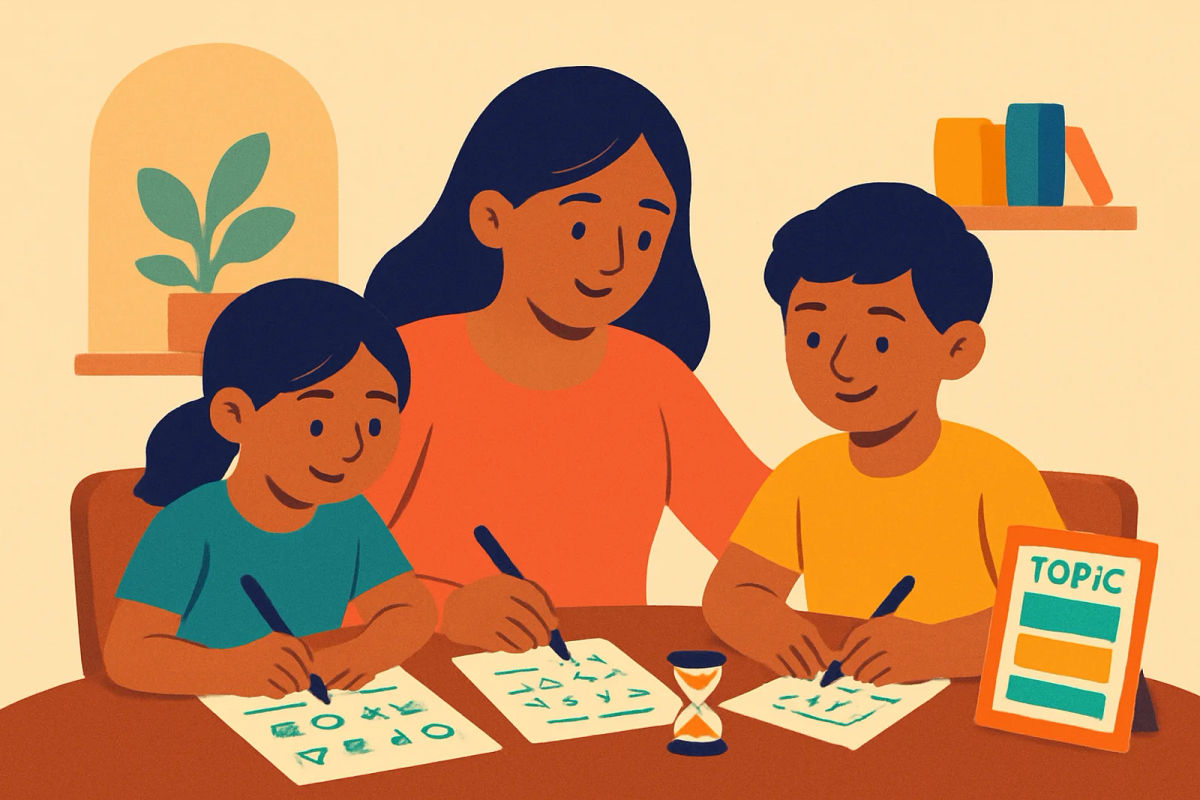
Short, planned practice can make December maths revision calmer and more useful than a large bundle of sums. This guide shows you how to use maths revision worksheets for class 1 to 5, track topics, mix question types and help your child check mistakes.
In short
- Use one small maths skill in each 15-minute practice block.
- Check your child's school portion before choosing worksheets or making questions.
- Teach your child to find and correct errors instead of simply showing the answer.
- Use mixed questions after separate topic practice, with six to ten questions at a time.
- Let the topic tracker guide the next practice block rather than treating it as a score.
Why short maths revision sessions work better
A large bundle of sums can make a child feel that revision will never end. A 15-minute block gives one clear job, such as adding two-digit numbers or reading the time. Your child can focus on the method, complete a manageable set and still have time to check the work.
On school days, try one block after a snack and a short rest. A second block may work later if your child is still fresh. At the weekend, use one longer review with a break in the middle. For example, a Class 1 child might practise number bonds for 15 minutes, a Class 3 child might solve multiplication problems, and a Class 5 child might revise fractions and word problems.
Stop or reduce the number of questions when your child is tired or making the same error repeatedly. More sums at that point may add confusion. Make a note of the difficult step and return to it the next day with fewer, clearer questions.
Make a topic list for your child's class
Start with a list of topics that may appear in the December exam. Common areas include number names, place value, addition, subtraction, multiplication, division, fractions, money, time, measurement, shapes and data handling. Do not assume that every topic belongs in the exam portion.
Read the school textbook contents, check the notebook and look at recent test papers. Cross out chapters the teacher has not included. Also note the method used in class, such as carrying in addition, borrowing in subtraction or a particular way of showing fractions. Class 1 may need counting, number bonds, basic operations, money, time and simple shapes. By Class 5, the list may include larger numbers, fractions, decimals, geometry, measurement, data and multi-step word problems.
Print or copy this simple tracker on A4 paper. Add one row for each topic.
| Topic | Date practised | Confidence | Next step |
|---|---|---|---|
| | | Ready, practise or help | |
| | | Ready, practise or help | |
| | | Ready, practise or help | |
Keep the tracker beside the worksheets so your child can see what comes next.
Plan five days of 15-minute practice
Use one topic each day and keep the same simple pattern: 2 minutes to recall, 10 minutes to solve and 3 minutes to check. On Monday, a Class 1 child could recall number bonds. Tuesday could be addition, Wednesday time, Thursday subtraction and Friday a short mixed review. A Class 5 child could revise fractions, decimals, area, word problems and then use a mixed page on Friday.
A home plan may look like this:
- Monday: practise one new or weak topic.
- Tuesday: repeat the method with different numbers.
- Wednesday: work on another topic from the tracker.
- Thursday: solve a few questions without help.
- Friday: complete six to ten mixed questions and check them.
Teachers can use the same plan with a small group. Keep the topic the same, but change the number range, pictures or question difficulty. One child may work with numbers to 20 while another uses three-digit numbers. A group can discuss one example together, then solve its own set quietly. Leave a little time to record one next step for the following week.

Lumi's tips
- Lumi suggests placing a pencil and a small timer beside the worksheet before your child starts.
- Lumi recommends writing the topic name at the top of every page so errors are easier to trace.
- Let your child choose between two ready topics when both fit the day's plan.
- Keep one corrected example in the notebook for a method your child often forgets.
Choose the right maths revision worksheets for class 1 to 5
Choose a small worksheet that matches your child's class, current topic and exam portion. Begin with a one-page topic practice sheet, such as place value or equivalent fractions. After your child has practised several separate skills, add a mixed-question page. A page with fewer suitable questions is often easier to discuss than a full test paper.
A printable worksheet or the Math Worksheet Generator can give you changed numbers and another page for extra practice. This helps you offer a fresh set without making your child repeat the same paper from memory. Select questions that resemble the work done at school.
Before printing, check the method. Some classrooms teach carrying and borrowing with written columns, while others use place-value steps. Class 5 children may need a particular layout for long division or fraction answers. Keep the worksheet close to the textbook and notebook. If the page uses a method your child has not learnt, pause and teach that method first rather than expecting them to guess it.
Use mixed-question pages without overwhelming your child
Mixed questions are useful after your child has practised each skill separately. They ask the child to decide which operation or method is needed, rather than following one repeated pattern. Start with six to ten questions, not a crowded page containing every topic in the syllabus.
For Class 1 or 2, a mixed page might include one addition question, a time question, a shape question and a money question. For Class 4 or 5, it could combine fractions, decimals, measurement and a small data table. Leave enough space for written steps and diagrams.
Write a small topic code beside each question. For example, A could mean addition, T time, S shapes, F fractions and D data. When your child makes an error, mark the code on the tracker rather than simply putting a cross on the page. If three questions marked F cause trouble, the next 15-minute block should return to fractions. This makes the mixed page useful for planning instead of turning it into a score.
Teach an error-checking routine children can follow
Give your child the same five-step routine each time a question seems wrong:
- Read the question again and underline what it asks.
- Check the operation or method used.
- Recalculate, using a different check where possible.
- Compare units, signs, labels and the position of the decimal point.
- Write the correction neatly and explain the changed step.
A Class 1 child can count on, use objects or add again slowly. A Class 3 child can check addition with subtraction or multiplication with division. A Class 5 child can estimate first and then compare the answer with the estimate. Ask your child to label the mistake as a calculation error, reading error, fact gap or careless presentation error.
Instead of giving the answer, ask, "Which step will you check first?" You can point to the question, operation or unit, but let the child find the exact error. If the child cannot explain the method after a calm retry, record "needs help" and teach one small step before giving another question.
Track progress and adjust the final weeks
Look at the tracker every few days and use it to choose the next 15-minute block. A simple symbol system can show the next action without becoming a mark sheet. Use a tick for ready, a small circle for needs practice and a question mark for needs help. These signs describe what to do next, not how clever your child is.
For a weak topic, reduce the question number and use worked examples, counters, a number line or squared paper. For a confident topic, keep the practice short but add variety, such as a word problem or a question with missing information. A child who can calculate well may still need practice reading what a problem asks.
In the final days, plan one calm mixed review using familiar topics. Give enough time for checking and stop before the child becomes worn out. Do not add a new chapter at the last minute unless the teacher has specifically asked for it. Keep the notebook, tracker and corrected worksheets together so your child can review the methods that have already been practised.
Questions parents ask
How many maths questions should a Class 1 to 5 child solve in a 15-minute session?
There is no fixed number because questions differ in length and difficulty. A Class 1 child may complete four to eight short questions, while an older child may manage six to ten questions with written steps. Stop when checking becomes rushed or repeated errors appear.
Should my child revise one maths topic at a time or use mixed-question worksheets?
Start with one topic at a time so your child can practise the method without guessing what to do. Use a mixed page after two or more skills have been revised. Keep the mixed page to six to ten suitable questions and mark each one with a topic code.
How can I help my child check maths mistakes without giving the answer?
Ask your child to read the question again, name the operation and try a checking method. Prompts such as "Which step will you check first?" or "Does your answer make sense?" guide the child without handing over the solution. Ask them to write the corrected step neatly.
Are printable maths revision worksheets suitable for CBSE and state board children?
They can be useful when the questions match the child's school textbook, class level, exam portion and written method. Check the notebook for the way the school shows carrying, borrowing, long division and fractions. Do not use a worksheet simply because its class label matches.
How can I make a simple maths topic tracker at home?
Draw four columns headed topic, date practised, confidence and next step. Add one row for each topic from the textbook and recent tests. Use symbols such as a tick, circle and question mark to show ready, needs practice and needs help, then choose the next short block from the tracker.