A school morning checklist for children: uniform and cooler November mornings
A school morning checklist for children can make cooler November mornings calmer and easier to follow. This guide helps you prepare a flexible uniform and packing list, then teach your child to complete one step at a time.
In short
- Adjust the checklist for your local weather, school rules and the warmer part of the day.
- Keep uniform items separate from optional sweaters, jackets and rainwear.
- Give your child one responsibility at a time, such as checking the identity card or water bottle.
- Use pictures for Nursery to UKG children and short written steps for Class 1 to 5.
- Review the checklist when it feels too long, unclear or difficult to follow.
Why November mornings need a flexible checklist
November mornings can feel cool in many parts of India, while the afternoon may be warm by the time your child returns home. A child may need a sweater, socks, covered school shoes and a filled water bottle at the start of the day. The right choice will depend on your local weather and the school's instructions.
A useful checklist is flexible rather than fixed. Add a sweater or jacket on cooler days, remove it when the school asks children to leave it at home, and include rainwear if the weather calls for it. A child in Bengaluru, Delhi, Kochi or a smaller town may have a different morning routine in the same month.
The main aim is to help your child remember one step at a time. You do not need to check every item for them forever. Begin by doing the routine together, then let your child take over one small part while you stay nearby. The list becomes a quiet reminder instead of a long stream of morning instructions.
Make a uniform checklist that matches your school rules
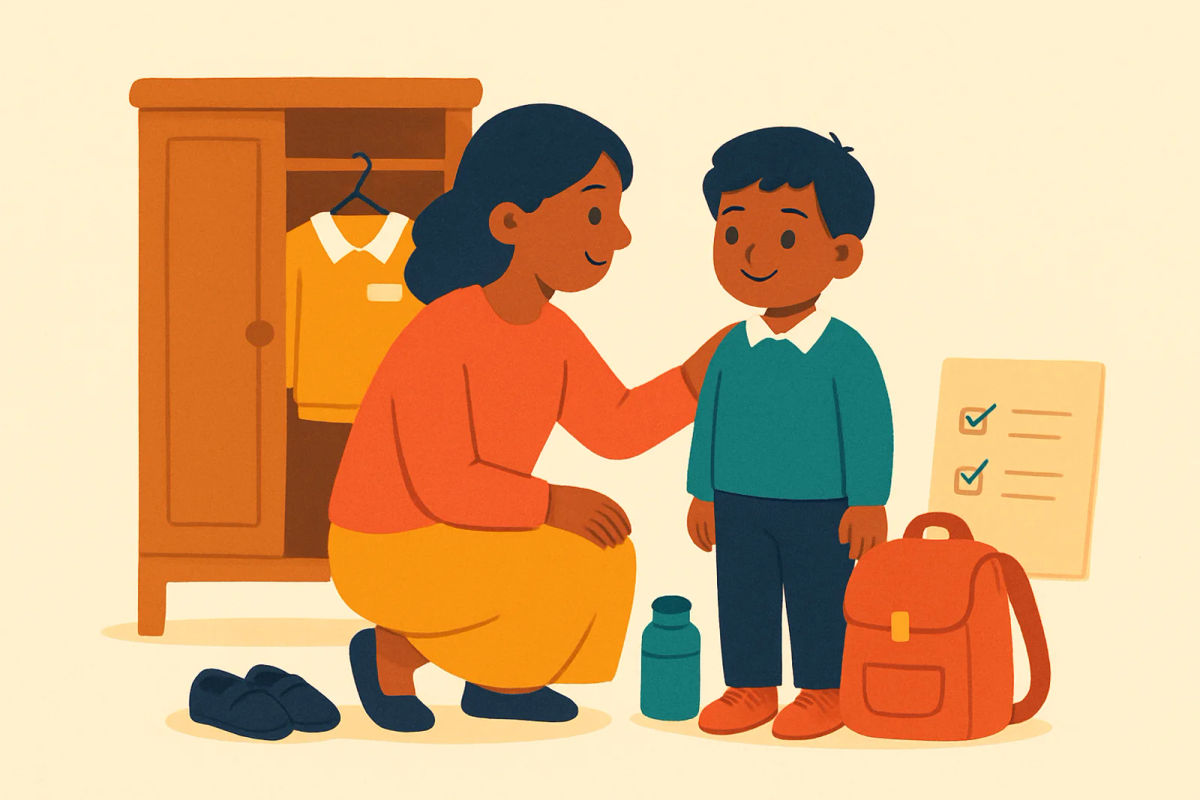
Start with the clothes your school requires every day. Check the school's diary or notice before making the final version. A simple uniform list may include:
- Shirt, trousers or skirt, and underclothes.
- Socks, belt and school shoes.
- Identity card and any required tie or hair accessory.
Keep the sweater, jacket and rainwear on a separate line called "only when needed". This helps your child understand that these items depend on the weather and school rules. Check whether the sweater has to be worn, carried in the bag or kept in the classroom.
Nursery, LKG and UKG children may need an adult to lay out the clothes in order. Class 1 to 5 children can usually check most items themselves, with a final adult review when needed. Common morning mistakes include wearing the sports uniform on a regular school day, leaving the identity card at home, or choosing unpolished or unsuitable footwear. The checklist should match your school's rules, including fixed sweater colours and permitted shoes.
Add a cooler-morning packing check
After the uniform check, your child can look at the school bag. The daily packing check can include a filled water bottle, lunch box, homework folder, pencil case and the books shown on the day's timetable. Add a notebook, art material or other class item only when it is actually needed. A shorter list is easier to use than one that names every possible object.
Check the sweater before the child leaves. It should have the child's name and should be worn or packed as the school instructs. A small evening station near the school bag can hold the water bottle, identity card and footwear. Keep the lunch box and books close by, but make sure food is packed fresh in the morning.
For example, a child in a school in Pune may leave home in a cool early morning wearing the approved sweater. The child can carry the water bottle and lunch box, then bring the sweater home or place it in the school bag if the afternoon becomes warm. A child in a warmer area may need only a light layer, or none at all. Let the local weather and school rule guide the boxes.

Lumi's tips
- Lumi says to keep the identity card, bottle and shoes in one evening station so they are easy to find.
- Use pictures and read each box aloud for a younger child, then let the child point to the next action.
- Keep a spare pencil and a named sweater only if your school allows them.
- Change the list when the season, timetable or school rule changes.
Build the school morning checklist for children
Put the actions in the order your child follows them. Use one short phrase and one small box for each action. For Nursery to UKG, add a simple picture beside each phrase, such as a bed for wake up, a tap for wash and a bag for pack. You can use a Name Tracing Worksheet Maker activity to help a young child practise recognising their name on a sweater or identity card.
A picture-led list might say: wake up, use the toilet, wash, get dressed, eat breakfast, pack the bag, check clothes, wear shoes, leave. A word-based Class 1 to 5 list can use the same order with more detail, such as "Check today's books" and "Put on the identity card". You may also point children to Back to School Activities for a simple school routine activity.
Read the list aloud at first. Then point to each box while your child completes the action. Give time for the child to finish before moving to the next box. If breakfast is late or a school bus arrives early, keep the list as a guide and help with the next necessary step rather than turning it into a test.
Teach responsibility in small steps
Responsibility grows through repeated small actions. Begin with one task, such as placing the identity card in the bag every evening. When your child manages that regularly, add the water bottle. Later, ask the child to check the sweater and shoes before asking for help with less familiar tasks such as reading the timetable.
Use calm prompts that direct attention to the list. "What is the next box?" or "Which item are you checking now?" is often more useful than repeating the whole morning routine. If the child forgets, point to the relevant picture or words and wait a moment. Younger children may still need you to name the item or show where it belongs.
For Class 1 to 5 children, a five-minute evening check can remove rushed decisions in the morning. The child can look at tomorrow's timetable, place the identity card near the bag, check the sweater and put the shoes together. Keep praise specific, such as "You checked the water bottle yourself." Avoid making the checklist feel like a punishment for forgetting.
Use the checklist at home or in a classroom
Print the checklist on A4 or US Letter paper at Actual size, which means 100%. You can also copy it onto a plain sheet and change the words or pictures to match your child's school. Files from EarlyActivity are PDFs sized for A4 and US Letter paper. The free printables library has other activities you can use alongside a school routine.
Place the page beside the wardrobe, near the school bag or on the wall by the exit. In a Nursery, LKG or UKG classroom, a teacher can place a copy on the departure board where children collect their bags. A Class 1 to 5 teacher may use it near the bag area for a final class check.
Put the page in a clear folder or laminate it so your child can tick each box with a whiteboard marker and use it again. An adult should review the list before printing. Some schools have fixed sweater colours, specific footwear rules or clear identity card policies. Add only what applies to your home or classroom. For other home activities, you can also visit Lumi at School Coloring Pages.
When the checklist is not working
A checklist may fail because it has too many items, uses unclear words or includes evening tasks in the morning section. Watch what happens for a few days. If your child stops looking at the page, remove repeated items and keep the actions that really help before school. Packing tomorrow's books belongs in the evening section if it makes the morning too crowded.
Make the list easier for a younger child by using pictures, fewer boxes and adult support. You can make it more demanding for an older child by adding a timetable check and a final bag check. Keep the last box simple, such as "Bag, uniform and water bottle checked".
If your child repeatedly struggles with dressing, packing or following everyday routines, speak with the child's teacher. This is especially useful when the difficulty affects school attendance or causes regular distress. The teacher may notice a classroom pattern or suggest a simpler routine. If there are wider concerns about your child's daily functioning, discuss them with your child's doctor as well. A checklist is a support, not a way to blame a child.
Questions parents ask
What should I add to a school morning checklist for children in November?
Add the usual uniform, a filled water bottle, lunch box, school books and identity card. Include a named sweater, jacket or rainwear only when the weather or school rule requires it. Check local conditions because November weather differs across India.
Should my child wear a sweater to school or carry it in the bag?
Follow your school's instructions first. On a cool morning, your child may wear the approved sweater, while a warmer afternoon may make carrying it more comfortable. Write "wear or pack sweater" on the checklist if the choice changes from day to day.
How can I help a young child follow a morning checklist without constant reminders?
Use a picture-led list with one action in each box. Read it aloud at first, then point to the next box and wait while your child completes it. Begin with one responsibility, such as checking the identity card, before adding more tasks.
What should be on a school uniform checklist for Nursery, LKG and UKG children?
Include the shirt, trousers or skirt, underclothes, socks, belt, approved shoes, identity card and any required tie or hair accessory. Keep sweaters, jackets and rainwear on a separate when-needed line. An adult can lay out the clothes while the child checks each picture.
How can I print and reuse a morning checklist at home or in my classroom?
Print the PDF on A4 or US Letter paper at Actual size, or copy it onto a sheet and adjust the wording. Place it near the wardrobe, school bag or classroom departure board. Put it in a clear folder or laminate it so children can tick the boxes with a whiteboard marker.