Children's Day activities for preschoolers at home: a kindness chart for Nursery and LKG
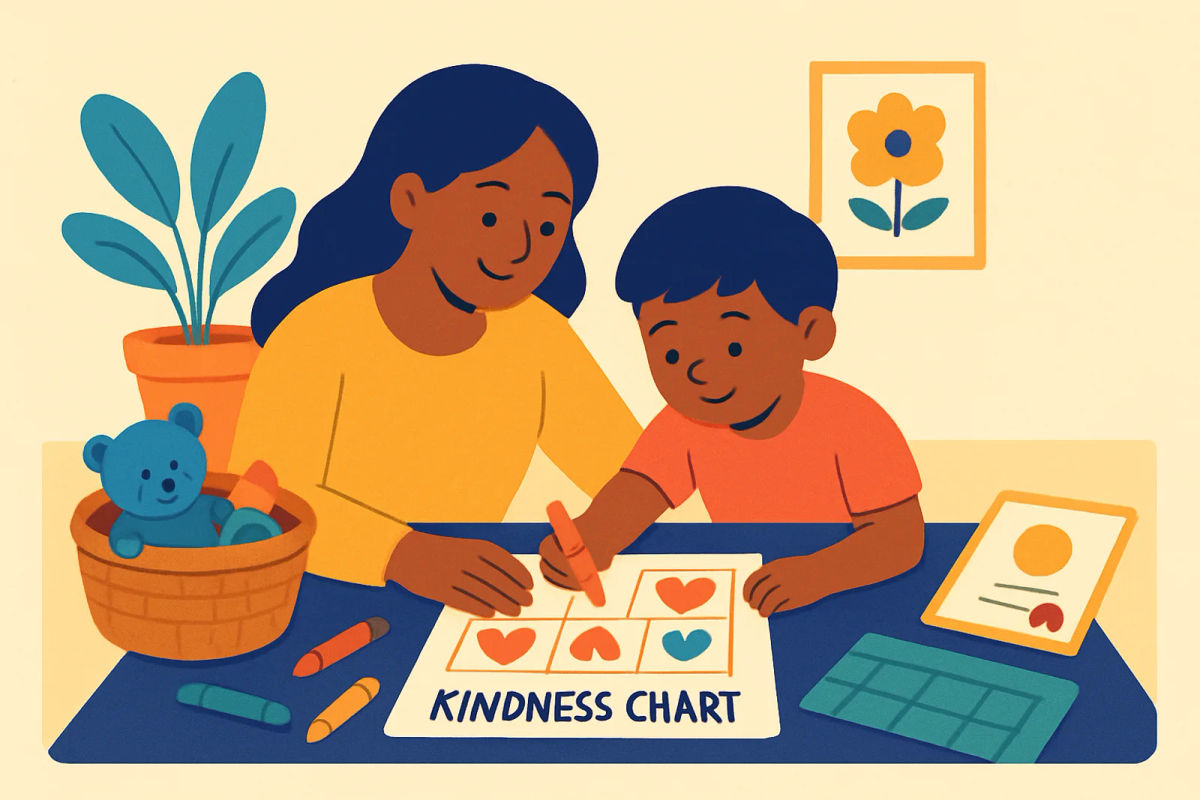
These Children's Day activities for preschoolers at home help your child notice small acts of care, such as making space, tidying toys and saying thank you. You can print a kindness chart and certificate, then guide your child to draw or colour each action instead of copying sentences.
In short
- A kindness chart helps children notice and practise small acts of care at home or in class.
- Nursery children can choose two or three actions and respond by pointing, speaking, drawing or colouring.
- LKG children can choose an action, try it and explain it in a few words.
- The chart records practice, not a contest, and children should never be compared.
- A short five-minute talk helps connect each action with the person it helped.
What does the kindness chart teach?
A kindness chart gives your child a simple way to notice how everyday actions help other people. The focus is on practice, not on collecting prizes or being called the best. A child may make space for a friend on a mat, put toys back in a basket or say thank you after receiving a snack, pencil or book.
Talk about kindness in words your child already understands. At home, it may mean helping to tidy blocks after play. In a Nursery or LKG classroom, it may mean passing a crayon, waiting for a turn or leaving space beside a friend. These actions are small, but they are part of living and learning with others.
The chart is a reminder to notice an action after it happens. Your child can colour a picture, add a sticker or make a small mark. There is no need to copy a sentence. You can pair the chart with other ideas in the Children's Day Activities collection when planning a home or classroom session.
How to prepare the chart and certificate
Print the kindness chart and certificate on A4 or US Letter paper. Choose Actual size or 100% in the print settings so the pictures and spaces keep their intended size. Keep the papers on a table with crayons, colour pencils or a few stickers. A thick crayon can be easier for a young child to hold than a sharp pencil.
Print one chart for each child if you want to notice individual actions. A teacher may instead place one shared chart near the book corner and invite children to add a mark after taking part. In a busy class, individual charts can be easier to manage because each child has a clear turn.
Write your child's name on the certificate before the activity, or use the Certificate Maker to prepare it. Keep the certificate simple. It should mark the child's effort after practising the actions, not promise a reward for every small task. Store the chart and certificate together in a folder if you plan to use them over several days.
How to introduce the activity on Children's Day
Begin with one action rather than explaining the whole chart at once. Tell your child what the action looks like in a familiar routine. For example, say that making space means moving a little on the mat so a friend can sit nearby. Helping to tidy means putting blocks into the box after play.
Act out each example with your child. You can sit on a mat and move over, build a small tower and put the blocks away, or pretend to receive a snack and say thank you. In class, a teacher can use a pencil, picture book or basket of toys for the same role-play. Keep the examples ordinary and easy to copy.
Tell children that they may draw or colour the picture after they try the action. They do not need to write a sentence or perform in front of the group. If a child watches first, that is fine. Offer another chance during snack time, free play or clean-up time, when the action has a real purpose.
Lumi's tips
- Lumi suggests keeping the chart beside the toy basket so your child can remember the action during clean-up.
- Use one sticker or one colour mark for an action. The conversation matters more than filling every space.
- If your child is tired, stop after one action and continue another day.
- In class, place the shared chart where children can reach it without crowding one another.
Simple kindness actions for Nursery children
Nursery children usually need just two or three choices. Too many actions can make the chart feel like a worksheet. Offer choices such as putting one toy away, making space for a friend or waving to show thank you. You can point to the pictures while naming the choices.
After the child tries an action, let them colour the matching picture, add a sticker or make a small mark with your help. Hold the paper steady if needed. A child may point to the action, make a sound or tell you one word instead of explaining a full idea. Accept these responses as part of taking part.
Try to use the action during a normal routine. Ask your child to put one car in the box rather than asking for a complete tidy-up. Move a cushion so another child can sit nearby. After handing over a snack or pencil, pause and model thank you without insisting on a long response. You can also offer simple colouring practice from the Big and Simple Animal Coloring Pages collection when your child wants a quiet activity after the chart.
How LKG children can use the chart more independently
LKG children can take a little more responsibility for choosing and recording an action. In the morning, invite your child to choose one picture from the chart. During the day, help them find a natural chance to try it. They might pass a crayon, help arrange books or thank the bus helper, grandparent or teacher.
Later, ask your child to explain what happened in a few words. You could ask, What did you do? and Who did it help? A short answer such as I gave Riya a crayon is enough. If your child does not want to speak, pointing to the picture or drawing the action is still a useful response.
Ask children to draw the action or colour the matching part of the chart instead of copying a sentence. They can draw two children sitting on a mat, books on a shelf or a hand passing a crayon. If they want to write their name or one word, let them try, but do not turn the activity into handwriting practice. Keep the chart connected to real actions, not neat work.
A short home or classroom routine
Set aside five minutes after playtime or before bed. In a classroom, this can happen just before children go home. Keep the chart nearby and talk about one action only. Ask, What did you do, and who did it help? Ordinary answers are welcome. Your child may say, I put one block away, or point to the child who received a pencil.
A simple routine could follow these steps:
- Look at one picture on the chart.
- Invite your child to remember or try the action.
- Let the child draw, colour or mark the picture.
- Thank the child for taking part and move on.
Give the certificate after your child has practised the chart actions. Write the date or add a small drawing if the space allows. A teacher can send the certificate home in the child's folder. At home, you can display it for a day and then keep it with the chart. The point is to remember the practice, not to make the certificate more important than the kindness.
Mistakes to avoid and ways to adjust the activity
Do not force a child to hug, share a personal item or say sorry before they are ready. Kindness does not mean giving up a comfort object or allowing someone to enter personal space. You can model another choice, such as making room on a mat, passing a classroom crayon or helping to return a shared toy.
Avoid comparing children or filling in the chart when a child has not taken part. If one child needs more time, leave the picture unmarked and offer another chance later. A chart should help children notice actions, not make them feel watched or judged.
For a child who needs more support, use fewer actions and clear picture prompts. Let the child choose between two pictures and accept pointing or drawing. For a confident LKG child, ask them to suggest a new helpful action, such as placing storybooks in a stack or carrying a light napkin to the table. Check that the action is safe and realistic before adding it to the chart.
Questions parents ask
How many kindness actions should a Nursery child do on Children's Day?
Two or three actions are enough for most Nursery children. Choose small tasks such as putting one toy away, making space or waving thank you. Stop when your child loses interest and offer another chance later.
Can my child draw the action instead of writing on the kindness chart?
Yes. Your child can draw, colour, point to a picture, add a sticker or make a mark with help. The chart is for noticing and practising actions, not for copying sentences.
Should I use a kindness chart for one child or for the whole LKG class?
Either option can work. Use one chart per child when you want each child to choose and record an action. A shared classroom chart works when the teacher prefers group participation and can give each child a clear turn.
What should I do if my child refuses to share or say thank you?
Do not force the response. Model a simple alternative, such as making space, passing a shared crayon or waving. You can say thank you yourself and offer the child another chance when the situation feels comfortable.
Can I print the kindness chart and certificate at home?
Yes. Print the files on A4 or US Letter paper at Actual size, or 100%. Most EarlyActivity printables are free, and downloading needs a free account. Free accounts can download up to 20 printables a day.