Constitution Day activities for Class 3 to 5: voting, fairness and data maths
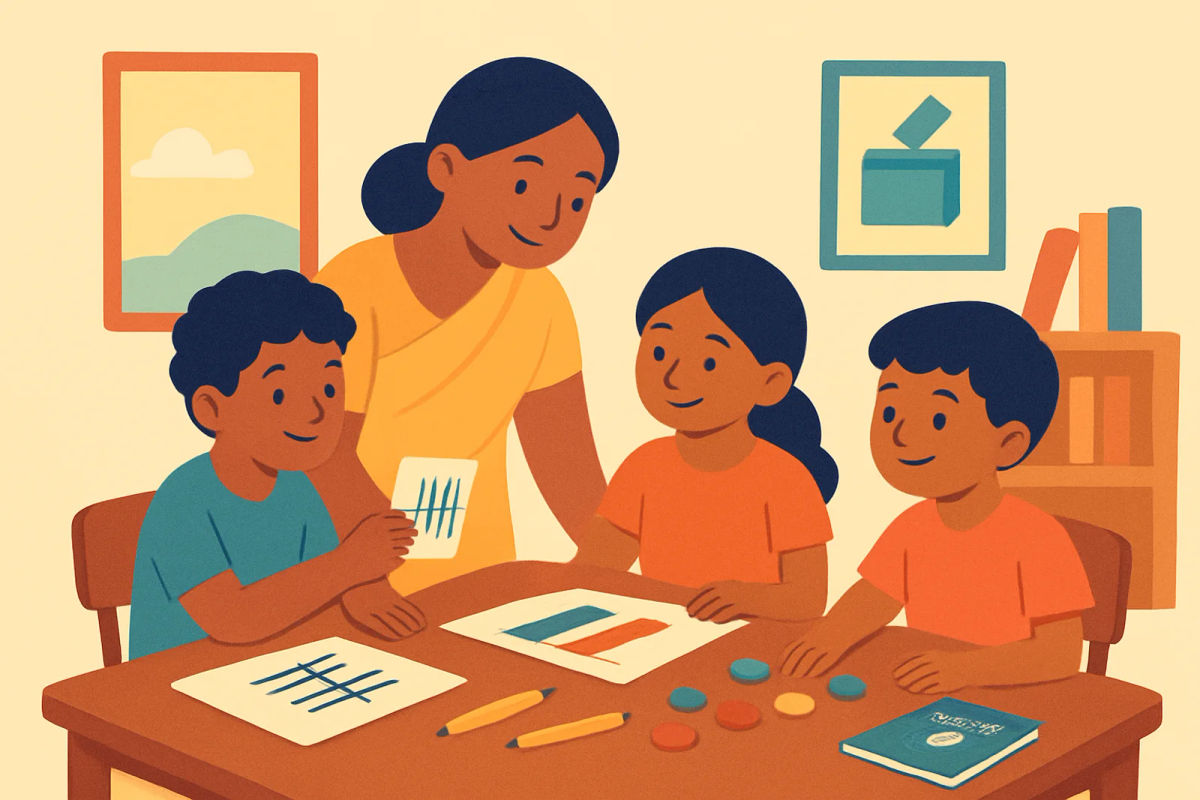
These constitution day activities for class 3 to 5 connect a simple class vote with fairness, equal participation and everyday maths. You will guide children as they record tally marks, draw a bar graph, compare fractions and explain their answers using a printable data worksheet.
In short
- A simple class vote gives children practice with tally marks, totals, bar graphs and comparison statements.
- Equal turns, clear rules and private choices help children discuss fairness in a safe classroom setting.
- Fractions can show how many voters chose one option out of the total class votes.
- The same worksheet can be used as an individual, pair or reasoning task for different class levels.
What will children learn from this activity?
This activity gives Constitution Day a practical classroom link. Children discuss simple ideas such as fairness, equality, participation and following agreed rules. They then use a class vote to collect data and represent it in more than one way.
The maths work can include making tally marks, finding totals, drawing a bar graph, comparing numbers and writing a fraction such as 8/24. Children also explain statements like, "Drawing received 3 more votes than the maths game." This helps them connect a number in a table with a sentence about the class.
Tell the class that this is a maths simulation, not a full lesson on the Constitution, elections or government. Keep the focus on taking turns, recording information accurately and treating each voter equally. You can introduce the activity after a short age-appropriate conversation about why communities need rules and why people should be heard.
For a related school celebration, you can place this lesson beside activities from the free printables library, choosing only work that suits your class time and reading level.
How can you set up a fair class vote?
Choose one simple, low-pressure question. For example, ask, "Which activity would you like for the last 20 minutes of the day?" Offer three or four clear choices such as a library corner activity, a maths game, a drawing task or a quiet reading time. Each child gets one vote.
Explain the rules before anyone votes. Tell children how votes will be recorded, whether the choice will be private, and what will happen if two choices have the same number of votes. A tie might be settled by a second vote or by giving both choices equal time. Make sure every child gets the same opportunity to take part.
Use a show of hands only for a simple choice where children will not feel judged. If the question is personal, allow children to write their choice on a small slip and place it in a box. Avoid questions about family income, marks, friendships or other private matters.
Write the question and choices on the board. Read each choice aloud and check that children understand what they are voting for before the recording begins.
How do children record votes with tally marks?
Prepare a table with one row for each choice. Leave columns for tally marks and totals. You can draw the table on the board, give each child a worksheet or let groups copy it onto chart paper. Start with a quick example. If five children choose a drawing task, show four vertical marks crossed by a fifth mark. Explain that groups of five make counting faster.
Ask children to record the votes carefully as each choice is announced. Then count each group of five and any marks left over. Write the total beside the tally marks. A useful classroom example might be 9 votes for a library corner activity, 7 for a maths game and 8 for a drawing task.
For Class 3, focus on making, grouping and reading tally marks. Class 4 and Class 5 children can check whether the sum of all the choice totals matches the number of voters. If 24 children voted, the row totals together should be 24.
Watch for tally groups of six, marks placed in the wrong row and totals that do not match. Ask children to check the table with a partner before moving to the graph.

Lumi's tips
- Lumi suggests writing the voting rules on the board before you hand out any recording sheets.
- Lumi suggests using counters or bottle caps when Class 3 children find fair sharing difficult to picture.
- Lumi suggests asking one child to read the table while another checks the graph height.
- Lumi suggests keeping personal questions out of a show-of-hands vote and using private slips instead.
How do you turn the data into a bar graph?
Use the tally table as the source for the graph. First, help children write a clear title, such as "Class votes for the last activity". Label one axis with the activity choices and the other with the number of votes. Children should choose a scale that fits the data and leave equal spaces between the bars.
Class 3 can use one square for one vote. If the choices received 9, 7 and 8 votes, the bars should reach 9, 7 and 8 on the vertical scale. Class 4 and Class 5 can try a scale of two votes or five votes per interval when the numbers make this sensible. Remind them that the scale must be labelled clearly.
Ask questions such as:
- Which choice received the most votes?
- Which choice received the fewest votes?
- How many more votes did one choice receive than another?
Finish with a checking step. Children compare each bar height with the tally total. A bar that looks close is not enough. Its height must show the exact number in the table. You can create extra practice numbers with the Math Worksheet Generator before class.
How can you use fractions and fair sharing?
Choose one row from the vote and ask children to write its votes as a fraction of the total. If 8 out of 24 children chose drawing, write 8/24. Explain that the numerator tells us the number choosing drawing and the denominator tells us the total number of voters. Children should use the same total class votes when comparing choices from one vote.
Ask whether 8/24 is more or less than one-half. Discuss why the largest group may still be less than one-half of the class. The most popular choice does not always have support from most children.
Add a fair-sharing problem using objects. For example, ask children to divide 24 counters equally among four teams. Then ask how many each team receives. Another option is to share 12 chart sheets equally among six groups. Class 3 can use counters, paper squares or bottle caps and focus on halves and quarters. Class 4 and Class 5 can simplify familiar fractions, such as changing 8/24 to 1/3, and explain how they know.
Keep the link clear: equal sharing is one way to discuss fairness, while voting fairness depends on equal turns, clear rules and accurate recording.
What reasoning questions and mistakes should you discuss?
After the graph and fractions are complete, ask children to think about changes to the data. Would the result change if two children changed their votes? What might happen if the choice with the fewest votes were removed? If five more children joined the class, would the present fractions still show the same part of the group?
Discuss why giving every child one vote is fair for this classroom activity. Explain that real decisions can need more rules, careful representation and different ways of considering people's views. Keep the explanation brief and suitable for the class level.
The most popular choice is not automatically the fairest choice when materials, turns or access are unequal. If one activity needs a limited number of art kits, the class may need a sharing plan even after voting.
Check for common errors:
- Tally groups of six or marks in the wrong row.
- Bars that do not match the totals.
- A missing title, scale or axis label.
- Children receiving unequal voting turns.
- Fractions using the number for one choice as the denominator instead of the total voters.
Ask children to correct one error and explain why the first answer was wrong.
How can you use the printable data worksheet?
A printable data worksheet can keep the activity organised. Choose a sheet with spaces for the voting question, choices, tally marks, totals, a bar graph and written answers. Before printing, decide whether children will use the real class data or a set of numbers prepared for practice.
Print the PDF on A4 or US Letter paper at Actual size, or let groups share one copy on a clipboard or chart paper. If you use a free graph or worksheet maker to change the class size, choices or numbers, check the scale and answer key yourself before handing it out.
For Class 3, use the sheet as an individual follow-up. Children can copy tally marks, count totals and answer the most and fewest questions. For Class 4, use pairs so children can compare the table with the graph and write differences between choices. For Class 5, add fraction comparisons, fair-sharing questions and error checking.
Leave time for children to explain one answer aloud. A worksheet shows the final work, but a short explanation can reveal whether a child has read the graph correctly or simply copied a number.
Questions parents ask
How can I teach Constitution Day maths without making the lesson too political or difficult for Class 3?
Keep the lesson centred on classroom rules, equal turns, accurate recording and fair sharing. Use a simple choice such as a class activity and avoid detailed discussions about government or political parties. Explain that the vote is a maths simulation connected to the idea that people should be heard.
What is a good class voting question for tally marks and a bar graph?
Ask, "Which activity would you like for the last 20 minutes of the day?" Give three or four choices, such as a maths game, a drawing task, a library corner activity or quiet reading. Each choice should be easy to understand and suitable for the available time and materials.
How can I explain fair voting and equal turns to children?
Tell children that each person gets one turn and one vote in this activity, and that the same recording rule applies to everyone. Explain that private voting can help children choose freely when a question feels personal. You can also point out that fair decisions may need more rules when resources or access are unequal.
Which parts of the worksheet should Class 3, Class 4 and Class 5 complete?
Class 3 can complete the question, tally marks, totals, a one-square-per-vote graph and simple comparison answers. Class 4 can work in pairs on the full table and graph, including differences between totals. Class 5 can add fraction simplification, fair-sharing reasoning and checks for incorrect scales or denominators.
How can I check whether children have read the graph and fractions correctly?
Ask each child to point to the bar and table row that support an answer. Check that the fraction denominator is the total number of voters, then ask the child to explain what the numerator represents. Give a new comparison question orally so you can see whether the child can use the data rather than copy a written answer.