How to make Diwali worksheets for kids: a safe learning pack for Nursery to Class 2
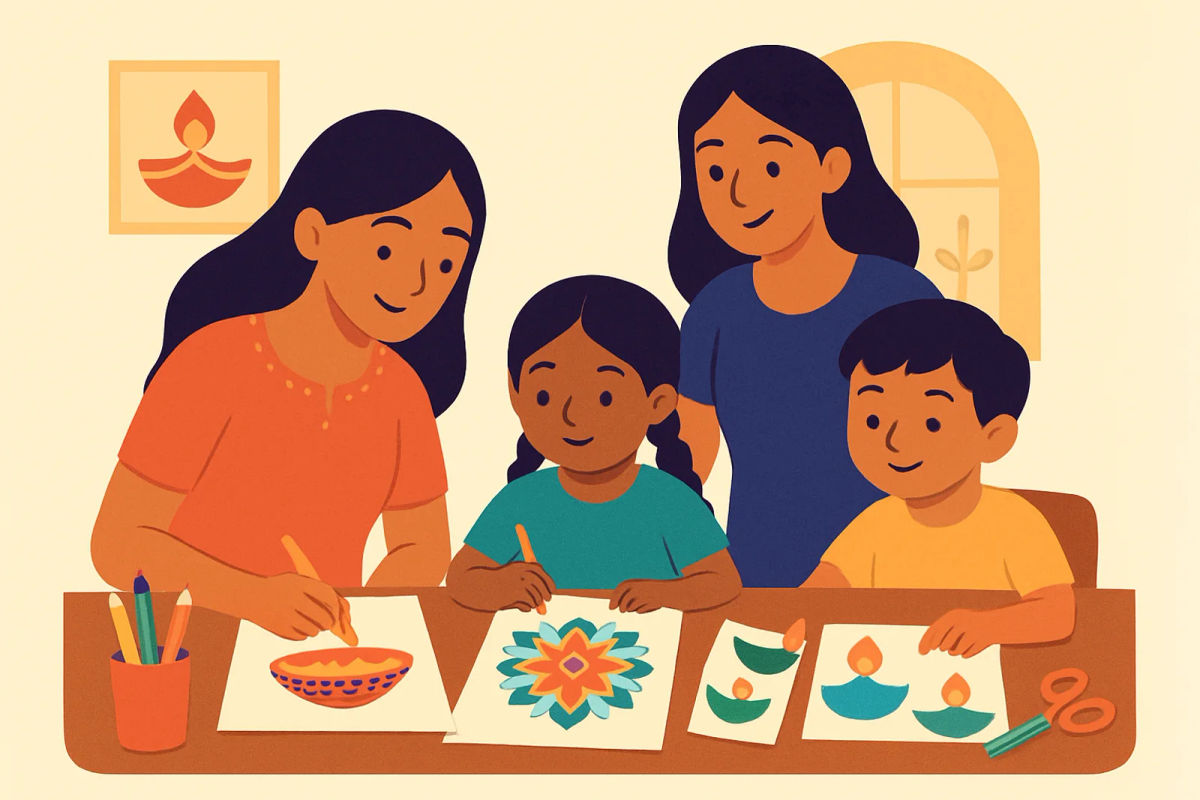
Plan a small, secular learning pack with tracing, counting, symmetry, vocabulary and colouring tasks for Nursery to Class 2. These Diwali worksheets for kids can be prepared for October to November 2026 and used at home or in your own classroom.
In short
- Keep the pack short, clear and suitable for the child's age and writing skills.
- Use diya tracing, lamp counting, rangoli symmetry and festival vocabulary to practise early learning skills.
- Choose secular topics such as light, patterns, colours, sharing and classroom creativity.
- Keep real diyas, flames, fireworks, matches and hot oil away from children.
- Print A4 or US Letter PDFs at Actual size, or 100 percent, for the correct page layout.
What should go into a Diwali learning pack?
A useful pack can be small and varied. Include one diya pattern tracing page, one lamp-counting page, one rangoli symmetry task, one short festival vocabulary page and a few simple colouring pages. Each page should have one main task, clear instructions and enough blank space for a young child's hand movements.
Keep the learning secular. Children can work with light, patterns, numbers, colours, sharing and classroom creativity without being asked to follow a religious practice. A cover page can say Diwali Learning Pack and include the child's name, class and date. Prepare the pages for October to November 2026 so a teacher or parent can use them before the school break or during the season.
Save the files as PDFs in A4 or US Letter size. Print at Actual size, 100 percent, rather than choosing a setting that shrinks or enlarges the page. You can begin with the Diwali Worksheets collection and select pages that match your child's age. For Nursery and LKG, two or three activity pages may be enough for one sitting. UKG to Class 2 children can manage a slightly longer pack with writing and maths practice.
How can you make diya pattern tracing pages?
Begin with a large diya outline that is easy to see. Add a curved flame above it and a few wide dotted patterns for Nursery and LKG children to trace with a crayon or pencil. A page may have one large diya, followed by short lines, dots, waves and loops. These simple marks help children practise control without making the page feel crowded.
For UKG and Class 1, place repeated lines, dots, waves and loops inside or around the diya. Ask children to copy the pattern along the rim or below the flame. Class 2 children can make their own border pattern and write a short label such as My diya. Keep the dots dark enough to follow and leave space between each line.
After tracing, children can colour the diya. Tell them that real diyas and flames are handled by adults. Avoid tiny decorations, crowded borders and very light dotted lines, since these can be difficult for young children to see and follow. You can pair the page with Diwali Coloring Pages for an extra colouring task, but give a young child only one or two pages at a time.
How can children practise counting with lamps?
For Nursery, LKG and UKG, show groups of one to ten lamps. Leave a clear space between each lamp so the child can point to one picture at a time. Under the group, write a simple instruction such as Count and circle the number. Other useful instructions are match, colour and write the number. Use large numerals and keep the choices close enough to read but far enough apart to avoid confusion.
Class 1 and Class 2 children can work with groups of lamps up to 20. Add simple tasks such as 6 lamps plus 3 lamps, 12 lamps minus 4 lamps or a missing number in a counting line. Use pictures for the first examples, then let children solve a few number sentences without pictures. A page from the Free Printable Math Counting Worksheets collection can give you more ideas for the layout.
Read the instruction aloud for younger children and let them touch or mark each lamp as they count. Check every group before printing. A clear gap between pictures helps children avoid counting the same lamp twice. If a child is still learning numerals, offer a small number card or write the possible answers at the bottom of the page.

Lumi's tips
- Lumi suggests starting with one tracing page and one counting page, then adding more only if your child still has energy.
- Keep a spare sheet nearby for testing the print size and checking that dotted lines are easy to see.
- Lumi likes giving children two colour choices first, then allowing them to choose more colours for the final page.
- For a mixed-age group, keep the picture the same and change the instruction, such as colour for a younger child and label for an older child.
How can a rangoli page teach symmetry?
Start with half of a simple rangoli pattern on one side of a vertical centre line. Ask children to colour or complete the matching half. Use large dots, petals and straight or curved lines rather than detailed designs. Explain that symmetry means both sides match. The aim is to notice and copy a pattern, not to make every child create an exact traditional rangoli.
For Nursery and LKG, provide two simple outlines and ask children to use the same colour on both sides. They can also paste paper circles, triangles or petal shapes along each side of the centre line. Use child-safe scissors and glue with adult help. A teacher can draw the centre line in a darker colour so children know where one side ends and the other begins.
For UKG to Class 2, include vertical symmetry, pattern completion and a blank grid for creating a design. Let children check their work by folding a spare paper copy along the centre line, if suitable for the class. Accept close matches, since hand control is still developing. Talk about colours, shapes and repeated patterns while children work.
Which festival vocabulary should children learn?
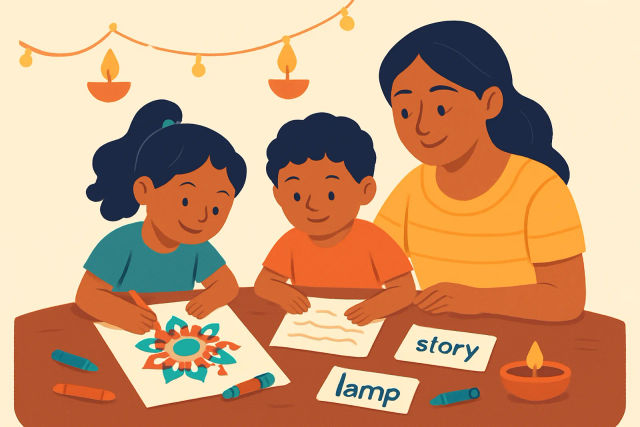
A short picture-word page is easier to use than a long word list. Choose familiar words such as diya, lamp, light, rangoli, colour, family, sweets and safe. Place one clear picture beside each word. For Nursery and LKG, read the words aloud and ask children to match pictures to words. They can point, repeat, colour the picture or draw a line between two matching items.
For Class 1 and Class 2, add missing letters, simple sentences and a draw-and-label task. Examples include This is a lamp and I see a rangoli. Keep the sentences short and use words children have heard at home or school. You may add Hindi equivalents such as diya, deepak or roshni when they support the child's classroom or home language. Do not make translation a test unless it is part of your learning goal.
Read the words slowly and accept different accents and home-language explanations. A child may know the object well but need more time to write the English word. Pair vocabulary with a drawing or colouring task so the page remains active. The Diwali Activities for Kids collection can provide more simple conversation ideas for a class or family setting.
How can you add colouring pages and a printable activity pack?
Choose simple colouring pages with diyas, lamps, rangoli shapes, stars, lanterns and family scenes. Avoid copyrighted characters and religious instruction. Use clear black outlines, wide spaces and one main task per page. A child should be able to understand the picture without needing a long explanation. You can use the Diwali Crafts for Kids collection for ideas that add paper shapes or simple making tasks after the worksheet.
Make one short pack for Nursery and LKG with tracing, counting, matching and colouring. Make a slightly more challenging pack for UKG to Class 2 by adding writing, pattern completion, addition and subtraction. A worksheet tool can help you change names, numbers and page difficulty before printing. For example, the Name Tracing Worksheet Maker can create a name page, while the Math Worksheet Generator can help with number practice.
Place the cover first, then arrange pages from easier to harder. Add space for the child's name and class on each page if the pack will be used in school. Check that every line is dark, every picture is complete and no task is split awkwardly across two pages.
How should adults use the pack safely?
Print two or three pages at a time instead of giving a young child the whole pack. This makes it easier to explain the task, notice when the child needs a break and keep unfinished pages tidy. Use crayons, pencils, child-safe scissors and glue with adult supervision. Keep real diyas, matches, fireworks and hot oil away from children. A colouring or paper-lamp activity can be used when a child cannot safely handle a flame.
Invite children to talk about how their family marks the season, while respecting families who do not celebrate Diwali. A teacher can say, Some families celebrate Diwali, and some do not. We can learn about light, colour, patterns and kindness together. This keeps the activity welcoming in a mixed Nursery, LKG, UKG or primary classroom.
Download printable activities for use at home or in your own classroom. Do not share or resell the files. Most EarlyActivity printables are free, and downloading needs a free account. A free account can download up to 20 printables a day. EarlyActivity Plus is an optional paid membership with no ads and more downloads. Files are PDFs for A4 and US Letter paper, so print at Actual size, or 100 percent, before starting.
Questions parents ask
How many pages should a Diwali learning pack have for Nursery to Class 2?
There is no fixed number. For Nursery and LKG, start with two to four pages, such as tracing, counting, matching and colouring. UKG to Class 2 children may use five to eight pages if the pack includes writing, symmetry and simple maths, with breaks between tasks.
What are safe Diwali activities for children who cannot use real diyas or fireworks?
Use diya tracing, lamp counting, rangoli colouring, paper shapes, vocabulary matching and paper lantern pictures. Children can make a pretend lamp from paper and talk about light without using a flame. Keep real diyas, matches, fireworks and hot oil away from children.
How can I make Diwali worksheets easier or harder for different age groups?
For Nursery and LKG, use large pictures, dotted lines, counting to ten and matching tasks. For UKG to Class 2, add pattern completion, missing numbers, addition, subtraction, labels and short sentences. You can also keep the same picture and change the instruction for each age group.
Can I print these Diwali worksheets for kids at home or in my classroom?
Yes. EarlyActivity printables are for use at home or in your own classroom. Downloading needs a free account, and files are PDFs sized for A4 and US Letter paper. Print at Actual size, or 100 percent, and do not share or resell the files.