How to prepare for school exams at home without cramming
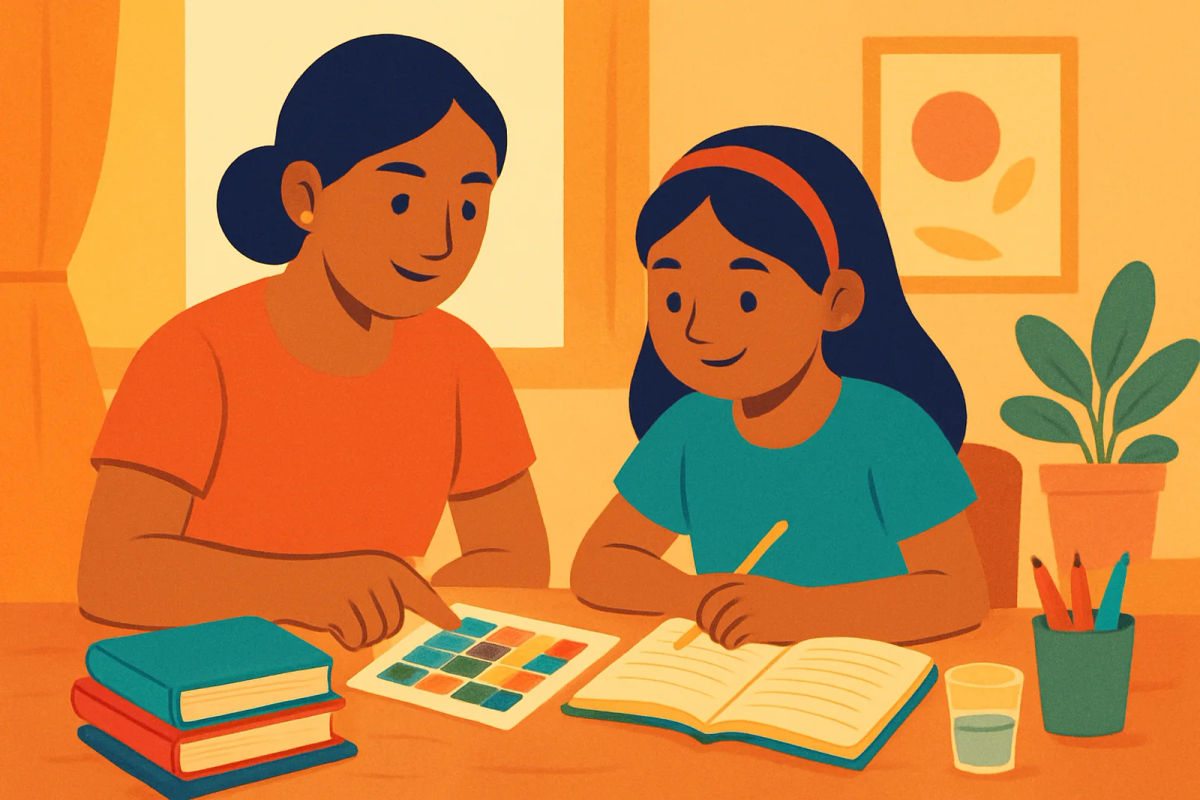
Learn how to prepare for school exams at home by turning the school portion into small tasks, asking retrieval questions and revisiting weak areas. You will also find simple routines, subject checklists and practice ideas for Classes 1 to 5.
In short
- Collect the actual school portion before making a revision plan.
- Use short daily sessions and retrieval questions instead of long rereading periods.
- Mark exact weak skills so your child can practise them again later.
- Use subject checklists and small practice sets instead of daily full mock exams.
- Keep the final week calm, focused and connected to the school's instructions.
Start with the school portion, not a large study plan
Before making a timetable, collect the information your child will actually be tested on. Check the syllabus or portion sent by the school, notebook work, textbook chapters, worksheets and teacher messages. A chapter in the textbook may not be included, while a notebook question may need careful revision.
Write each subject as small tasks. One task could be addition with carrying, two pages of English reading, a Hindi spelling group, one EVS topic or a science diagram. A small task is easier to fit between school, homework and family time.
Make a table with four headings: topic, date to revise, confidence and doubts. Your child can mark confidence with ready, needs practice or needs help. Keep doubts specific, such as "I forget where to place the tens digit" rather than "I do not know maths".
A free printables library can help you find a revision page or tracker to print. You can also draw a simple tracker on paper. Let your child tick a task only after doing some practice, not just after reading the heading. Keep the page beside the school books so it remains useful each day.
Make a realistic daily revision routine
Revision works better when it fits the family's real day. Do not add a long evening block after a full school day, homework, travel, meals and play. A short session before dinner and a brief oral review after reading may be enough for one day.
For Class 1 and 2, try a routine such as this:
- 15 minutes of reading aloud or handwriting
- a 5 minute movement or water break
- 15 minutes of maths with counters, drawings or sums
- 5 to 10 minutes of oral questions for EVS, English or Hindi
For Class 3 to 5, try 20 minutes of maths practice, a short break, 20 minutes of written answers, and 10 minutes of memory-based revision such as definitions, spellings, diagrams or dates. Adjust this when your child has tuition, sports, family travel or a tiring school day.
Teachers can use the same idea as a five to ten minute starter. Ask two questions from yesterday's lesson, give one quick sum or ask children to label a diagram. A routine should guide the child, not fill every free minute. Sleep, meals and unhurried preparation for school still matter.
Use retrieval questions instead of rereading
Retrieval means closing the book and asking your child to say, write, draw or solve what they remember. Rereading can feel familiar, but a short question shows what the child can bring back without help. Keep the first round brief and let your child check the book afterwards.
Use questions linked to the school books:
- Maths: Solve 46 + 28 in a new way. Which operation would you use in this word problem? Explain where the carrying goes.
- English: What happened first in the story? Give one describing word for the character. Use the new word in a sentence.
- Hindi: बोलकर दो नए शब्दों का वाक्य बनाओ. Read the word, cover it and write it from memory.
- EVS or science: Name three features of a plant. Draw and label a leaf. Why do we need clean water?
- Social studies: Name two points from the lesson. Show a place on the map or explain one local example.
For younger children, use pictures, objects, choices and one-step prompts. For Classes 4 and 5, ask for a short written answer, a labelled diagram or an explanation in the child's own words. Turn textbook headings, notebook questions and lesson keywords into five-minute question rounds.

Lumi's tips
- Lumi suggests keeping the revision tracker where your child can reach it and mark it independently.
- Ask for one answer, one explanation or one worked sum before opening another worksheet.
- Use a fresh example when checking a weak skill, so you can see what your child truly remembers.
- Keep a small doubt list for the teacher instead of trying to solve every repeated error at home.
Mark weak areas and revise them again
After a question round or a small practice set, mark each topic as ready, needs practice or needs help. The useful part is recording the exact difficulty. "Subtraction" is too broad. "Forgets borrowing across a zero" tells you what to practise next.
Other notes might say "misses capital letters", "spells three words incorrectly", "cannot label the roots", "mixes up map directions" or "writes a phrase instead of a complete sentence". Your child can help choose the mark, which makes the tracker a record of learning rather than a list of complaints.
Return to a weak topic after one day, then again later in the week. Use a fresh example instead of repeating the same question until it is memorised. Do not spend every session on favourite work just because it feels comfortable.
If the same error appears several times, ask the teacher what the child may have misunderstood. Share the exact question and the child's working when possible. A teacher can show whether the problem is a missing step, an unclear word, a language difficulty or a different method used in class. Avoid guessing and giving many extra pages before you know the issue.
Use subject checklists and short practice papers
A subject checklist turns a pile of notebooks into a clear page. Depending on the school portion, include each chapter, skill, formula, spelling group, definition, diagram and type of question. For maths, list place value, addition, subtraction, multiplication, division, fractions or shapes only when they are part of the child's work. For languages, include reading, grammar, spellings and writing tasks from the school books.
A short practice set can check a few skills without becoming a full mock exam. For example, choose two addition sums, one word problem and one question that asks the child to explain a step. For science, ask two definitions, one diagram label and one short answer. For English, include a few spellings, a reading question and one sentence-writing task.
Use a timer only sometimes. First look for careful reading, correct working and checking. A Math Worksheet Generator can help you make focused maths practice, while the Multiplication Table Generator is useful when tables are part of the school portion. Print one checklist for each subject and keep completed work nearby. This reduces last-minute searching through notebooks and helps you choose tomorrow's task.
Change the method for different ages and subjects
Children in Classes 1 and 2 usually need visible, spoken and hands-on revision. Use counters for place value, picture cards for EVS, flashcards for words, reading aloud, short dictation and one-step questions. Ask the child to point, match, say or show before expecting a long written answer. Handwriting Practice Tracing may help when letter formation needs slow, careful practice.
For Classes 3 to 5, add written recall, mixed maths problems, short-answer practice, diagrams and explanations in the child's own words. In languages, revise reading, spellings, grammar and a short composition from the school's examples. In maths, mix calculation with word problems and ask the child to show working. In EVS and science, use labelled drawings, comparisons, definitions and local examples. In social studies, revise key facts, sequence, maps and reasons when these appear in the portion.
Do not assume that one revision sheet suits every school. CBSE and state board schools can use different chapter names, methods and question styles, and even two sections in the same school may have different instructions. Check your child's own textbook, notebook and teacher messages before choosing practice. Use the school's wording where possible so the child recognises the question.
Avoid common cramming habits in the final week
The final week is not the time to restart every chapter from page one. Other habits can also make revision tiring: copying answers without first recalling them, studying late at night, handing over too many worksheets at once and correcting every line while the child is still working. These methods can fill time without showing which skill needs attention.
Use the tracker to choose the few weak areas that matter most. Give a small practice set, check it together and revisit errors the next day. Review key spellings, formulas, definitions, diagrams and school instructions. Keep the last evening for light reading, packing pencils and other materials, checking the timetable and going to bed at a reasonable time.
Praise careful effort with specific words, such as "You checked each place value column" or "You corrected that spelling after looking at the sound." Ask useful questions about the work, then talk about ordinary things too. Every conversation at home does not need to become an exam.
Teachers can send home a focused list with the exact chapters, skills and a few practice suggestions. A short, clear revision note is more useful than a large bundle of unclear worksheets. Parents can then support the same method at home without adding unrelated work.
Questions parents ask
How much time should a Class 1 to 5 child study at home before December exams?
There is no single useful number for every child. Classes 1 and 2 may manage a few short sessions of 10 to 15 minutes, with breaks and oral revision. Classes 3 to 5 can often use two or three focused sessions of about 15 to 25 minutes, adjusted for homework, travel, health, sleep and the school portion.
How can I know which school topics my child needs to revise first?
Start with the school's portion, notebooks, textbook chapters and teacher messages. Ask a few questions or give a small practice set, then mark each topic as ready, needs practice or needs help. Begin with topics that are included in the exam and show repeated errors, not simply the topics your child likes least.
What are good retrieval questions for maths, English, EVS and science?
For maths, give a fresh sum and ask the child to explain the method. For English, ask about a story event, a word meaning or a sentence using new vocabulary. For EVS and science, ask the child to name features, explain a reason, sort examples or draw and label a diagram. Keep prompts simple for younger children and ask for short written explanations in Classes 4 and 5.
Should my child complete sample papers every day before exams?
No. Daily full papers can become tiring and may hide the exact skill that needs practice. Use short sets focused on two or three skills, and use a complete paper occasionally to practise reading instructions, time use and checking.
How can I help my child revise without making them anxious or tired?
Plan short sessions around school, meals, play and sleep. Give one clear task, allow movement breaks and talk about specific effort rather than marks alone. If your child is repeatedly distressed, unusually tired or struggling to attend school, speak with the class teacher and seek medical advice when needed.