How to teach story sequencing to children with four picture cards
Learn how to teach story sequencing to children with four picture cards, using first, next, then and last before asking for writing. You will be able to guide an oral retelling, sort events into beginning, middle and end, and finish with a short writing task.
In short
- Sequencing means putting story events in the order in which they happen.
- Use first, next, then and last while your child moves four picture cards.
- Let your child retell the story aloud before asking for written sentences.
- A beginning-middle-end chart helps children see how four events make one short story.
What does story sequencing mean?
Story sequencing means putting events in the order in which they happen. A child looks at what happened first, what came next, what happened after that and what happened at the end. Four simple words make this order easier to say: first, next, then and last.
Sequencing gives your child a clear way to speak before writing. For example, while getting ready for school, a child may say, "First I wake up. Next I brush my teeth. Then I put on my uniform. Last I pack my bag." The sentences are short, but the order is clear.
You can use the same pattern with a seed. First, a child puts a seed in the soil. Next, the child waters it. Then, a small plant grows. Last, the child sees a flower. As you practise, listen for the order rather than correcting every grammar mistake. A child who can point to the events and tell them in order has a useful starting point for later writing.
Choose a short story with four clear events
Choose a story with one main character and four actions that are easy to see. The pictures should show what the character does, rather than small clues that your child must guess. At the start, avoid stories with many characters, sudden changes in time or several problems.
For Nursery and LKG, use an everyday event such as washing hands before eating. The four pictures might show turning on the tap, using soap, rinsing hands and eating a snack. Your child already knows the routine, so attention can stay on the order.
For UKG and Class 1, choose a short story with a simple problem and ending. A child may lose a ball, look for it, find it under a chair and play again. Name the characters and actions as you show the pictures. For Class 2 to 5, you can include a little more detail, but keep the main sequence easy to follow. You can print suitable pages from the free printables library and cut out the cards for repeated use.
Use the four picture cards step by step
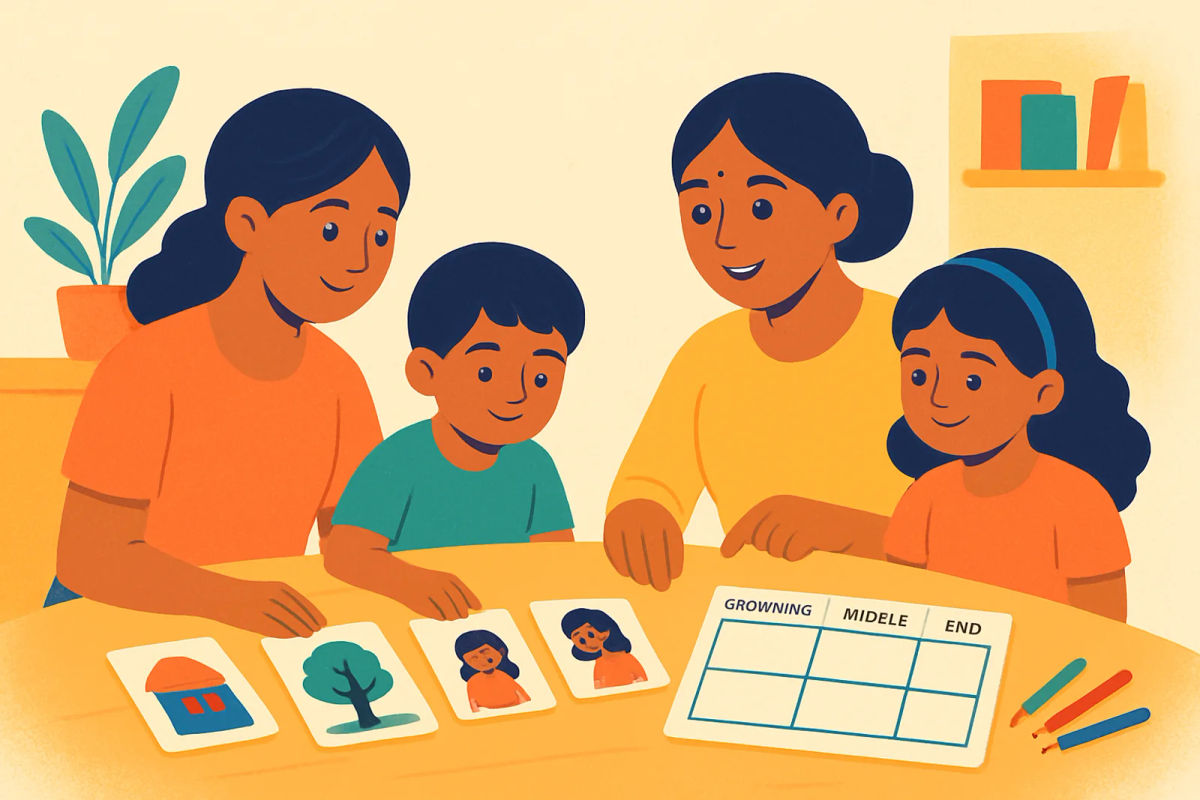
Place the four cards in a mixed-up row. Ask your child what they notice, without asking for the correct order straight away. This gives you a chance to hear which details the child understands.
Help your child find the first card by asking, "What happened at the beginning?" When that card is placed, say, "First..." Ask what could happen next, then add the third card with "Then..." Finish with "Last..." Keep the cards in a row so the growing order stays visible.
Ask simple reasoning questions such as, "Why does this card come before the child eats?" or "What had to happen before the plant grew?" Accept answers based on the picture and repeat them in a clear sentence. If your child changes the order, move the cards together and talk through the actions again.
A cut-and-use set of printable sequencing cards can be kept in an envelope or pouch. The same cards can be used for sorting, speaking and partner work. A free Photo to Coloring Page tool can also help you make familiar picture prompts from simple objects or classroom scenes.

Lumi's tips
- Lumi's tip: Keep the four cards on the table while your child speaks, so the order stays visible.
- Use actions from home, such as packing a school bag, when a story feels too difficult.
- Give your child time to think before supplying the next word.
- Store each card set in a labelled envelope so you can practise again another day.
Practise an oral retelling before writing
Point to each card from left to right while your child retells the story aloud. Use a sentence frame when needed: "First the boy finds a seed. Next he plants it. Then he waters it. Last a small plant grows." Your child can repeat the frame with different words as confidence grows.
Accept simple sentences first. If the child says, "Boy seed," you can respond, "Yes, the boy finds a seed in the garden." This adds who, what and where without stopping the retelling for too many corrections. You can ask one gentle question at a time, such as, "Where does he plant it?"
For a group, give each pair one set of cards. One child points and retells while the other listens, then they change roles. Invite a few children to share with the class. Hearing several versions helps children notice that the same order can be told with different words. Keep the oral part brief, perhaps two or three minutes, and stop while the story is still familiar.
Move from pictures to beginning, middle and end
After your child can retell the four cards, introduce a beginning-middle-end chart. Explain that the beginning introduces the character or situation, the middle shows what happens, and the end shows the result.
Ask your child to place the first card in beginning, the next two cards in middle and the last card in end. Read the story again while pointing to each part. For the seed story, the beginning shows the boy finding the seed, the middle shows him planting and watering it, and the end shows the plant growing.
This grouping helps children see how several events can form one short story. It also gives them a simple plan for speaking and writing. Ask, "Who is in the beginning? What changes in the middle? What is different at the end?" Older children can explain the problem and solution in their own words. If a child says only, "He finds it," prompt with, "What problem did he have, and how was it solved?" Keep the chart beside the cards so the child can look back while answering.
Add a short writing task
Offer an optional three-sentence writing page after the oral retelling feels clear. Ask your child to write one sentence for the first event, one sentence for the next or then event and one sentence for the last event. The cards can stay on the table as a visual plan.
Nursery and LKG children can draw each event, dictate a sentence for you to write or copy key words such as seed, water and plant. They may also trace a short sentence if that suits their current practice. The purpose is to show the order, not to produce a long paragraph.
UKG and Class 1 children can use a word bank with words such as boy, seed, soil, water and plant. Class 2 to 5 children can add joining words, describing words and details about where or how something happened. Ask them to check that each sentence matches one card and that the sentences stay in order. You can find other printable practice pages in the free printables library, then choose a page that matches your child's writing level.
Common mistakes and simple fixes
A common mistake is asking for a full written paragraph before the child can tell the story aloud. Return to the cards and practise the oral version first. Writing becomes more manageable when the child already knows what happens in each part.
If your child guesses from one picture only, ask, "What happened before this?" and "What happened after it?" If first, next, then and last feel confusing, begin with two cards. Practise first and last, then add next and then when the child is ready.
Some children remember all the events but cannot speak in order. Let them point to each card while speaking. You can say the first word of each sentence and allow the child to finish it. Praise the child for explaining why one card comes before another.
A free maker can help you create prompts from simple classroom actions, familiar objects or a story read that day. Use four pictures with one action in each. If you need a quick set, take simple photos of washing hands, packing a bag or planting a seed, then turn them into picture prompts with a Photo to Coloring Page tool. Keep the language and pictures familiar.
Questions parents ask
At what age can children start learning story sequencing?
Children can begin with two everyday picture cards in Nursery or LKG. Use familiar routines such as washing hands or putting on shoes. Add four cards when your child can talk about the actions in a simple order.
What should I do if my child puts the picture cards in the wrong order?
Ask what happened before and after the card your child chose. Act out the events or talk through the routine together, then let your child move the cards again. Avoid giving the answer too quickly, as the explanation helps the child understand the order.
Should my child retell the story orally before writing it?
Yes, oral retelling gives your child a chance to plan the story and practise the order. Point to each card while your child speaks. When the retelling is clear, move to drawing, dictation, copying key words or writing three sentences.
How can I teach first, next, then and last without making the activity difficult?
Start with two cards and use first and last. Add next and then with a four-card story once the first pair feels easy. Repeat the same words during routines at home, such as getting dressed or preparing a snack.
Can I use four picture cards with a whole class?
Yes. Give each pair or small group one mixed-up set. Children can sort the cards, retell the story to a partner and explain one choice before a few groups share with the class. Keep the cards large enough for children to see from their seats.