How to use retrieval practice for primary students: simple study methods for Class 1 to 5
Retrieval practice for primary students means remembering an answer without looking at the book first. This article shows you how to use question cards, teach-back, quick drawings and short next-day review sessions for Class 1 to 5.
In short
- Ask your child to recall an answer before looking at the book or the back of a card.
- Use short question cards, teach-back explanations and quick drawings to check understanding.
- Sort questions into know, nearly know and practise again so the next session has a clear focus.
- Mix a few older questions with new ones and keep recall sessions short.
- Accept spoken answers and labelled drawings when writing is tiring, while still checking the ideas carefully.
What is retrieval practice?
Retrieval practice is a short activity in which your child tries to remember an answer without looking at the book, notebook or answer card. The child may say the answer, write it, point to it or draw it, depending on age and the subject.
Repeated reading can make a page feel familiar. Your child may recognise the words while reading, yet struggle to name the information when the book is closed. Recall gives you a clearer picture of what the child can bring to mind independently.
For example, after reading a page about plants, close the book and ask, "Can you name three parts of a plant?" The child might say root, stem and leaf. Then open the page and check the answer together.
This is not a long test or a way to pressure your child. Try two or three questions, keep your voice calm, and treat mistakes as useful information. The aim is to find the next small point to practise, not to catch the child out.
Start with closed-book question cards
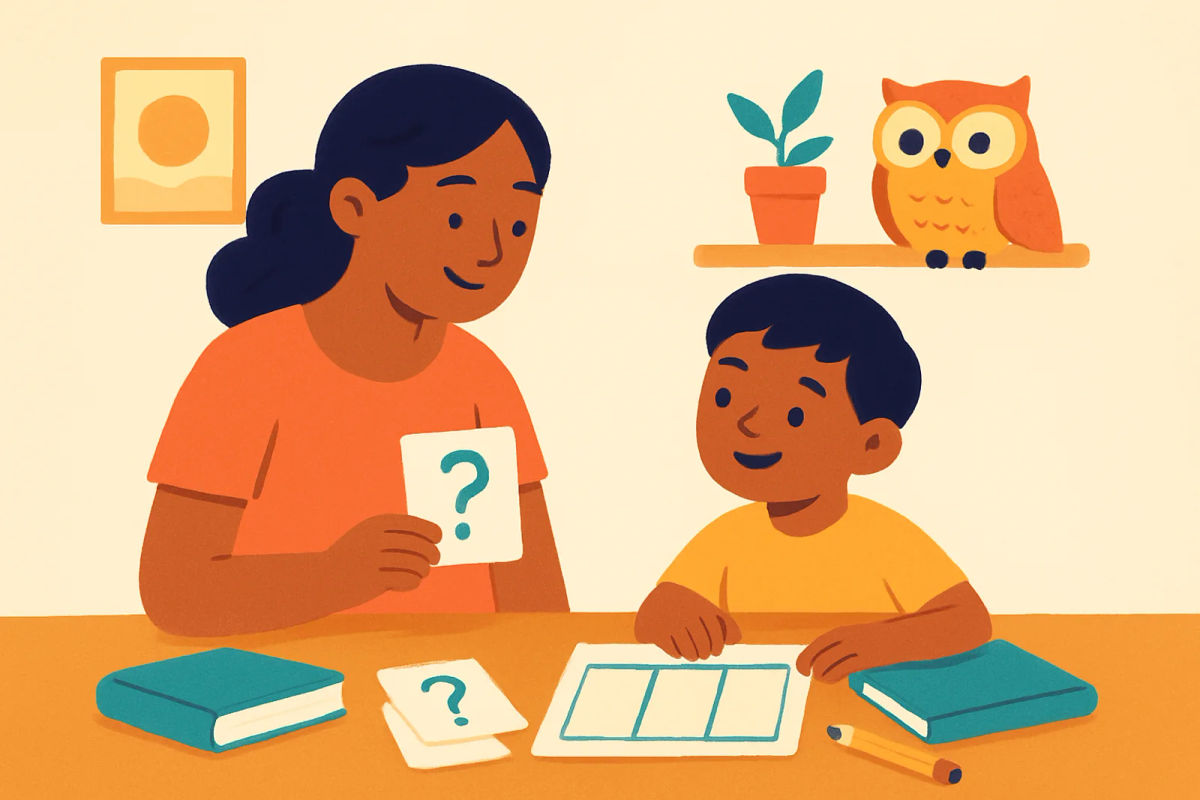
Turn one lesson into small question-and-answer cards. Write one question on the front and a short answer on the back. Use the wording from the child's textbook or classwork so the cards match what the teacher has taught.
For Class 1 and 2, cards might ask, "What is 7 + 5?" or "Name two domestic animals." For Class 3 to 5, try questions such as, "Why do we need roots?" or, "Find the perimeter of a square with a side of 4 cm."
The child reads one question, puts the card face down, and says or writes the answer. Only then does the child turn the card over to check. If the answer is partly right, talk about the missing word, number or step before moving on.
You can make cards from paper, reuse old card, or print materials from the free printables library. Keep each set small, with the key facts and questions from one topic. Neat cards are helpful, but the recall attempt matters more than the decoration.
Use teach-back and quick drawings
Ask your child to explain one answer in their own words as if they were teaching a younger child. This can show whether the child understands the idea or has only remembered a sentence from the book.
Quick drawings work well for processes and connected ideas. Ask the child to draw and label the water cycle, a plant, a food chain or the parts of a map. The drawing does not need to be artistic. Look for the main parts and the correct order or links between them.
For younger children, accept spoken answers, pointing and labelled drawings instead of long written answers. A Class 1 child can point to a root on a plant picture and say what it does. A Class 4 or 5 child can add one reason, example or key word to the explanation.
If one point is unclear, correct that point and invite the child to say the whole idea again. For example, say, "The roots also hold the plant in the soil. Can you add that?" Avoid taking over the explanation or giving every sentence yourself.

Lumi's tips
- Lumi suggests keeping one small card set in a pencil box so recall can happen during a quiet five-minute break.
- Let your child choose whether to answer by speaking, writing or drawing when the idea can be shown in more than one way.
- Use a gentle voice and praise the careful attempt, not just a correct answer.
- Keep the chart visible for one chapter, then clear it and start a fresh topic.
Make a know, nearly know and practise again chart
A three-column chart helps your child see what to do next. Write the topic at the top, then place each question or card under one of these headings: know, nearly know and practise again.
Put a card in know when the answer is correct and clear. Use nearly know when the child remembers part of the answer but misses a word, reason or step. Put a missed answer in practise again. This makes a partly correct answer visible without treating it as a complete success.
After a short pause, ask the child to try the nearly know or practise again card once more. When the answer becomes clear, move it to know. A printable three-column chart can make this sorting easier, especially during a small group lesson.
Keep the chart for one topic or chapter. Do not turn it into a record of everything your child has studied. At the end of the session, the practise again column should tell you which few cards to use tomorrow.
Plan next-day recall in short sessions
Use a simple routine. Choose a small set today, close the book, ask the questions, check the answers, and mark the cards. The next day, repeat the missed cards before adding a few new ones.
For a young child, five to ten minutes is usually enough for one sitting. A Class 3 to 5 child may manage a slightly longer session, but stop for a break when attention drops. Short, calm practice is more useful than making the child sit with a book for a long time.
Mix two or three older questions with a few new ones. This keeps earlier learning active and shows you if an answer has become secure. Use the same notebook wording where possible, especially before a school test.
Cover-and-recall strips are useful at home. Write a question and answer in two sections, then fold or cover the answer. After dinner or before school, your child reads the question from a printed strip, says or writes the answer, and lifts the cover to check. A pencil, school notebook and a small set of strips are enough.
Adjust the method for Class 1 to 5
For Class 1 and 2, use pictures, oral questions, counting facts, letter sounds, spellings and one-step maths problems. Ask, "Which word starts with b?" or, "What comes after 39?" Let the child answer aloud or point before asking for writing.
For Class 3, include short definitions, tables, word meanings, labelled diagrams and answers in one or two sentences. A Multiplication Table Generator can help you prepare simple table questions, while the Math Worksheet Generator can provide extra practice for number facts.
For Class 4 and 5, use why and how questions, maths steps, science processes and social studies facts. Ask, "Why does the shadow change?" or, "What is the first step when finding the perimeter?" A child can explain the process aloud before writing it.
Let children write fewer answers when handwriting is tiring, but still ask them to recall the content aloud. Use the examples, spellings and terms from the child's textbook and classroom work. Cards should support the lesson, not introduce a separate set of words.
Avoid common recall mistakes
The answer should stay hidden while your child is guessing. If the child looks at the page or card too soon, the activity becomes recognition rather than a check of independent recall. Give a little thinking time, then allow the child to say, "I am not sure," and look together.
Do not make every card difficult or turn practice into a timed competition. Speed can distract from careful thinking, especially for younger children or for children who need more time to speak or write.
A partly correct answer should not be marked fully correct without discussion. Ask which word, step or reason is missing. Then let the child try the answer again in a clear form.
Avoid making too many cards at once. Start with the key facts and questions the child is expected to know from one topic. Praise careful effort, such as trying a second time or explaining a reason, and use missed answers to plan the next short session. If a child repeatedly cannot understand the lesson even with calm support, speak with the class teacher about the specific topic and the help needed.
Questions parents ask
How long should retrieval practice take for a Class 1 to 5 child?
Begin with five to ten minutes for Class 1 and 2. Class 3 to 5 children may manage a slightly longer session, but stop or take a break when attention drops. A few well-chosen questions are enough for one sitting.
Is retrieval practice better than reading the lesson again?
It checks something that repeated reading may not show: whether your child can remember the answer with the book closed. Reading still helps when learning a new topic, but short recall after reading gives you a clearer next step for practice.
How can I use retrieval practice if my child does not like writing?
Ask for spoken answers, pointing, matching, counting aloud or quick labelled drawings. Writing can be added for a few important answers, but the child can still practise remembering the lesson without writing every response.
What should I put on printable flashcards and cover-and-recall strips?
Use one clear question on each card or strip and a short answer on the hidden side. Include key facts, spellings, maths facts, definitions, labelled parts, reasons and steps from the child's own lesson. Leave out details that the child is not expected to know yet.
How often should my child revise questions marked practise again?
Ask the child to try them again after a short pause, then include them in the next day's session. Once an answer is clear, mix it with older questions after a few days so you can check that it remains easy to recall.