How to make a revision timetable for students in Class 1 to 5
A clear revision timetable for students helps your child practise a little at a time while keeping space for homework, meals, play and sleep. This guide shows you how to plan a weekly timetable, subject checklist and small certificate for steady revision at home or in class.
In short
- Plan two or three small revision goals each day instead of filling every hour.
- Keep reading and maths practise on several days across the week.
- Use a checklist to divide chapters into small tasks your child can finish.
- Leave time for sleep, play, meals and changes in the school or family schedule.
- Recognise steady effort with a dated certificate rather than marks or rank.
What makes a good revision timetable for students?
A good timetable gives your child a clear next step without making the day feel crowded. Primary children often manage short, regular practice more calmly than one long study period. A 10-minute reading session, a break and 15 minutes of maths can be more useful than asking a tired child to sit for an hour.
Start with the fixed parts of the day: school, meals, sleep, homework and play. Then choose two or three small revision goals. For example, your Class 2 child might read one page aloud, revise addition facts and answer three environmental studies questions. Leave some empty space for travel, guests, school projects or a slow afternoon.
Write the plan with your child when possible. Keep it flexible. Move a task to another day if the child is tired or schoolwork takes longer. A timetable is a guide, not a test. If your child needs extra reading practise, you can use the free printable sight words worksheets for a short activity rather than adding a large worksheet stack.
How much revision should children do each day?
The right amount depends on age, schoolwork, the child's energy and the time left before the exam. Nursery and Class 1 children may begin with 5 to 10 minutes of reading, oral questions or number work. Classes 2 to 5 may manage 10 to 20 minutes per subject, with a short break between sessions.
Try a plan such as this:
- 10 minutes of reading after a snack, followed by a 5-minute break.
- 15 minutes of maths practise after homework, followed by play.
- One short recall activity before dinner, such as spelling five words aloud.
Stop while your child is still working calmly. You do not need to use every minute on the timetable. If several exams are close together, keep the usual short sessions and give each subject one small daily goal. Add one extra session on only one or two days if your child remains comfortable. Sleep and play should stay in the plan, especially the night before an exam.
How to divide subjects across the week
Spread subjects across the week so your child meets important skills more than once. Reading and maths practise should appear on several days, rather than being left for the night before the paper. Add English, Hindi or another language, environmental studies, science and social studies according to the subjects taught at your child's school. Chapter order can differ between CBSE and state board classrooms.
For a Class 1 or 2 child, a sample week could look like this:
- Monday: reading, addition and English picture words.
- Tuesday: Hindi reading and environmental studies oral questions.
- Wednesday: reading, subtraction and handwriting.
- Thursday: English spelling and environmental studies textbook questions.
- Friday: reading, mixed maths and a light review.
For a Class 4 or 5 child, use 20-minute blocks for maths, English, Hindi or another language, science and social studies across the week. Place an easier task after a harder one. For example, follow a set of fractions questions with reading aloud. Use the free printable math subtraction worksheets when subtraction is one of the week's small goals.

Lumi's tips
- Lumi suggests writing one clear task in each box, such as "read two pages", instead of "revise English".
- Keep a pencil beside the timetable so your child can tick a finished task straight away.
- If a day changes, move the task kindly and continue from the next small box.
- Let your child choose the colour used for completed goals, while you keep the subject and task clear.
How to use the printable weekly timetable
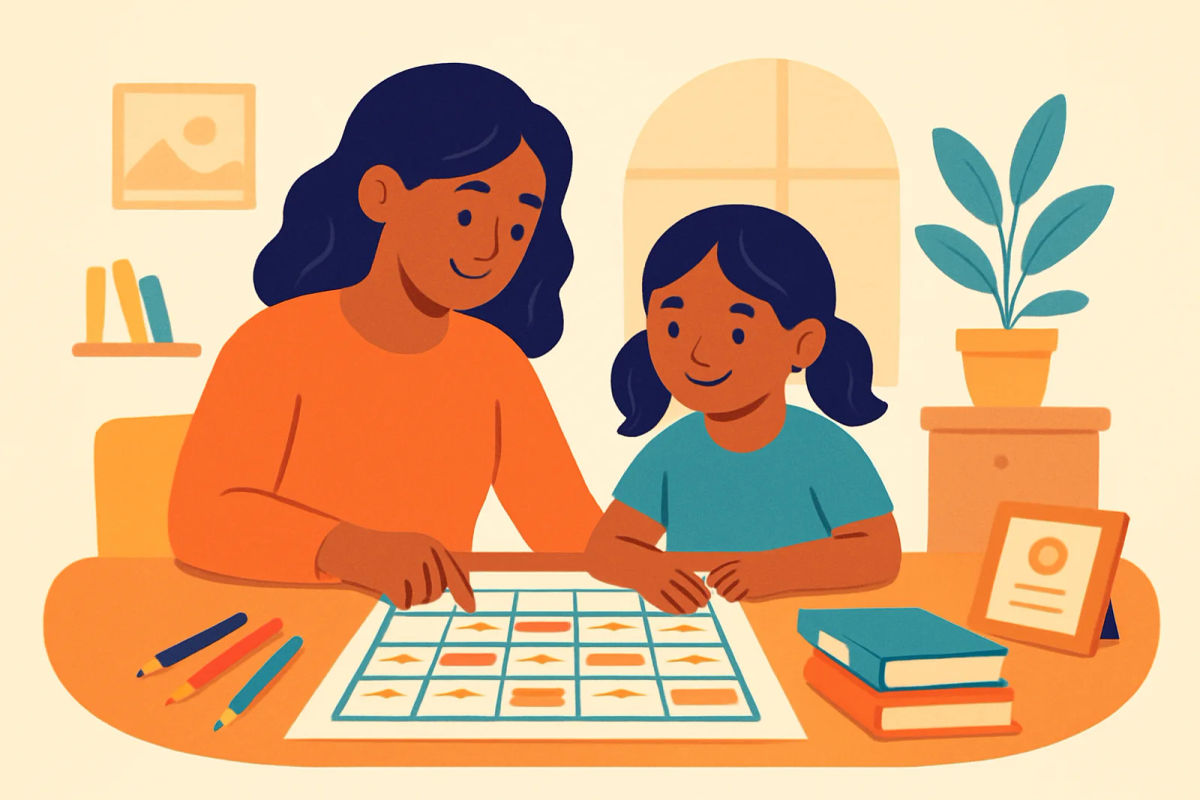
Print one weekly timetable for home or for each child in a class. Fill it in with your child on Sunday evening, Monday morning or the first school day of the week. Write the subject and one small task, rather than a broad instruction such as "study science". Include the date, a break and a box for a tick when the task is complete.
A useful layout is:
- Date: __________ Subject: __________
- Small task: __________________________________
- Break time: __________ Completed: [ ]
For example, write "Science: label parts of a plant" or "Maths: solve questions 1 to 5". Place the completed timetable near the study area, where your child can see the next task. A teacher can use the same sheet for a weekly classroom plan, then let children tick work as they finish it. Discuss any unfinished task without scolding, and move it to a sensible day.
The printable PDF can be printed at Actual size, 100%, on A4 or US Letter paper. Keep a pencil, eraser and coloured pencils nearby so your child can mark progress clearly.
How to use a subject checklist
A subject checklist turns a large chapter into small pieces. Make one checklist for each subject and use the wording from your child's textbook or notebook. A language checklist might include reading a chapter, learning spellings, writing five sentences and answering textbook questions. A maths checklist might include revising addition, practising tables, solving word problems and checking mistakes.
For a long chapter, split the work into boxes such as:
- [ ] Read pages 20 to 22.
- [ ] Underline or say five new words.
- [ ] Explain the main idea aloud.
- [ ] Answer questions 1 to 3.
- [ ] Check the answers with the notebook.
This helps you spot unfinished work without asking your child to repeat the entire chapter. In a CBSE or state board classroom, the teacher can share the topics already taught and children can compare them with their checklists. Do not assume that every school uses the same chapter order. Mark only the topics taught in that class. For word practice, the free printable word search worksheets can make one small language task less tiring.
How to make revision easier or harder
Adjust the task before adding more work. For younger children, ask oral questions, use picture clues, practise reading aloud and give one worksheet at a time. You can show three objects and ask your child to count them, read a short passage together or say the answer before writing it. This keeps revision manageable for Nursery, LKG, UKG and Class 1 children.
For Classes 3 to 5, add timed maths questions, short written answers, spelling tests and one practice paper when these match the school's work. A math worksheet generator can help you make a small set for a particular operation. Keep the set short enough to check carefully.
Ask your child to explain an answer, describe the steps or give an example. This tells you more than checking right or wrong alone. In class, children can compare their checklists with the topics the teacher has taught, then circle one topic they need to ask about. To make work easier, reduce the number of questions. To make it harder, ask for an explanation, a new example or a mixed set of familiar questions.
Mistakes to avoid during exam revision
A timetable becomes unhelpful when every minute is planned. Leave gaps for bathing, meals, travel, family plans and rest. Avoid giving many worksheets just because an exam is near. Your child needs sleep and play as part of a steady routine. A shorter task completed calmly is more useful than a long task completed in tears.
Do not compare one child's speed with another child's speed. Children may need different amounts of time to read instructions, write or recall facts. First check that your child understands what to do. If the task is "revise the chapter", explain whether you mean reading, oral recall, writing answers or correcting mistakes.
Speak with the teacher if your child remains very worried, cannot manage the schoolwork over several days or is regularly unable to begin tasks. Share the timetable and checklist so the teacher can see what has been attempted. The teacher may help you choose fewer topics or clarify the expected work. If worry or sleep problems continue beyond exam preparation, discuss this with your child's doctor as well.
How to finish with a small certificate
A small certificate can mark a completed goal, such as reading five times, finishing a maths checklist or completing three calm revision sessions. Base it on effort and finished tasks, not marks or rank. Choose the goal together at the start of the week and write it clearly on the certificate.
You can use this wording on a sheet:
Certificate of steady revision
This certificate is given to __________ for completing __________. Date: __________. Parent or teacher signature: __________.
After the final goal, let your child colour the border, add a signature and write the date. Keep it in a folder or display it near the study space for a few days. You can make a printable version with the Certificate Maker. EarlyActivity has printable activities for children aged about 2 to 12, including worksheets, puzzles, crafts and other resources. Most printables are free after you create a free account. Downloading needs a free account, which can download up to 20 printables a day. Files are made for A4 and US Letter paper, and you should print at Actual size, 100%.
Questions parents ask
How long should a Class 1 child study each day before an exam?
Begin with short sessions of about 10 to 15 minutes, with a break between them. One reading session and one small maths or school-subject task may be enough on a normal day. Stop if your child becomes tired or upset, and keep sleep and play in the routine.
Should a revision timetable include weekends and holidays?
It can include a small amount of revision on weekends or holidays, especially for reading and tables. Keep the sessions shorter and leave plenty of time for family plans, outdoor play and rest. Move tasks when a holiday day becomes busy.
How can I help my child revise when there are several subjects in one week?
Write the exam dates first, then give each subject two or three small goals across the available days. Put reading and maths on more than one day, and mix a harder subject with a familiar task. Use a checklist so your child can see which topics are finished.
What should I do if my child refuses to follow the timetable?
Ask what feels difficult and reduce the first task to five or ten minutes. Offer a choice between two tasks, such as reading first or maths first, and fill in the next box together. If refusal continues or your child seems very worried, speak with the class teacher about the workload and expectations.
Can I make a revision timetable online or print one for home and school?
Yes. You can make a simple timetable in a document or spreadsheet, then print it for home or classroom use. EarlyActivity PDFs can be printed on A4 or US Letter paper at Actual size, 100%, and the same sheet can be filled in with a pencil each week.